
Domain and identity migrations often break because hidden dependencies go unnoticed. Here is how a structured approach prevents those failures and keeps the transition stable.
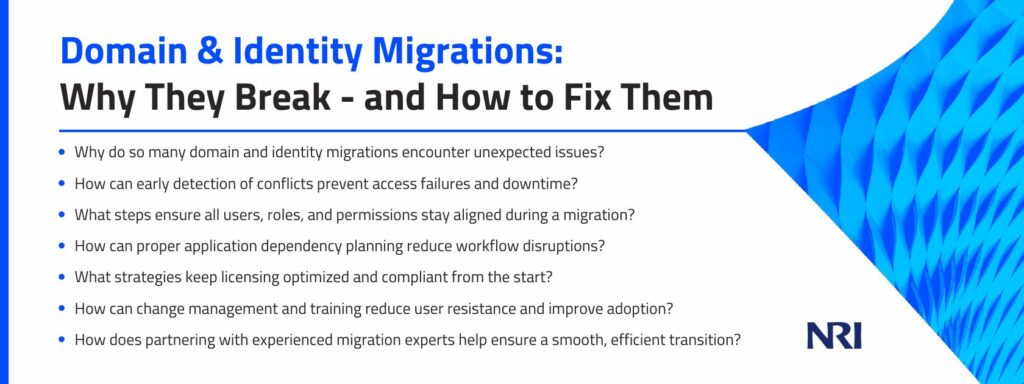
The idea of migrating your cloud often looks simple until it meets the realities of identity, security, and everyday user experience. Recent studies show that 62% of cloud migration projects either fail or become far more complex than initially planned, mainly due to hidden dependencies and identity misconfigurations.
A single misaligned license, an unexpected identity conflict, or an application still tied to an outdated authentication method can slow an entire migration. When these issues go unnoticed, downtime increases, users grow frustrated, and the overall security posture weakens.
This article outlines the five blockers that cause the most disruption and explains how NRI helps organizations move forward with speed and confidence.
Why Domain & Identity Migrations Are So Hard
Domain and identity migrations reach into almost every system your crew uses. Moving mailboxes is the easy part. The real work reshapes how people sign in, access tools, and conduct their everyday routines across the organization. Even a single misstep can spread quickly through teams and applications, creating problems that are difficult to unwind.
Several factors often make these migrations more complicated than expected
- Hybrid sync setups involving Azure AD Connect or third-party tools
- Cross-tenant domain moves inside Microsoft 365
- Legacy authentication remains tied to old servers or domain controllers
- Applications with hidden or undocumented identity dependencies
- Permissions and group structures that refuse to map cleanly from one environment to another
The stakes remain high throughout the transition. Downtime, authentication loops, broken applications, and exposed security gaps appear when identity is not handled with care. Weak planning slows progress and places unnecessary pressure on IT teams that are already juggling critical daily operations.
Why It’s Different With NRI
While most providers “execute the migration,” NRI goes beyond by engineering the transition from end to end. The process involves:
- Planning, identity cleanup, and development of a coexistence strategy
- Performing early dependency mapping to prevent application outages
- Aligning lifecycle and role-based identity as a standard practice
- Embedding adoption and change management from day one
Also, NRIs’ experience with Microsoft 365 migrations spans, Google Workspace, hybrid identity environments, and complex multi-domain architecture, giving you a partner who has seen and fixed it all.
Top 5 Challenges & Solutions in Domain and Identity Migrations
Domain and identity migration issues aren’t always obvious at first; they manifest as login failures, broken apps, or users suddenly losing access. Here’s what usually causes the trouble, and how NRI helps you avoid it.
- Coexistence Conflicts
Overlapping domains and duplicate identities are among the first hurdles most organizations face. When two environments try to manage the same user, you start seeing misrouted emails, login failures, and a hybrid setup that feels unpredictable and difficult to trust. If you have ever had users stuck in authentication loops, you know how frustrating they can be for both users and you.
NRI eliminates these issues early through deep identity and domain hygiene. The providers design clean cutovers or hybrid sync strategies that remove conflicts before they reach your users, ensuring authentication flows remain stable.
- Identity Sync Issues
Missed users and misaligned roles can lead to broken access, security gaps, and frustrated teams who suddenly can’t get to what they need. Orphaned accounts create hidden risks, and inconsistent identity attributes can silently disrupt daily workflows. These issues often appear at the worst possible time, just when you are in the middle of a project that demands things to run smoothly.
NRI addresses this with lifecycle-aware identity management from day one. They validate every user, role, and permission before migration to ensure your cloud investments stay secure and aligned. NRI’s approach focuses on:
- Ensuring the accounting of all user objects
- Correcting mismatched permissions or attributes
- Removing or flagging orphaned or duplicate accounts
This keeps your teams productive and access uninterrupted throughout the transition.
- Application Dependency Breaks
Many migrations derail because applications still depend on old domains, legacy authentication, or outdated connectors. The moment the migration starts, those apps stop working, and teams lose critical tools.
NRI solves this with careful, pre-migration dependency mapping. The specialists document the identity, permission, and authentication relationships behind each app, including hidden ones such as API callers, background services, and automations. This step matters even more when modern platforms like Microsoft Fabric are part of your environment, as identity consistency is essential for data pipelines and access layers.
Once mapped, they remediate any issues before cutover to ensure everything continues working smoothly.
- License Chaos
After a migration, you may discover that you are paying for unused licenses or holding entitlements that don’t match actual user roles. Or, you could realize compliance gaps that could result in costly penalties. Addressing these issues after the migration consumes time, budget, and resources better spent elsewhere.
NRI comes in with a structured post-migration licensing review that ensures clarity, optimization, and alignment from the start. Key actions include:
- Identifying unused or redundant licenses
- Right-sizing entitlements based on real usage
- Resolving compliance gaps before they escalate
This proactive approach establishes a clean licensing foundation, reduces waste, and keeps cloud investments efficient and compliant from day one.
- User Resistance & Low Adoption
Even when a migration goes perfectly from a technical standpoint, it can still fail if users don’t embrace the change. Often, people revert to old workflows or, worse, get locked out of critical systems.
That’s why a plan that stops at cutover is never enough. Effective migrations must include change management and training as core components.
NRI embeds those from the start. Before migration, users receive clear communication about what’s changing and why. Role-based training ensures each team knows exactly how to work in the new environment. After go-live, feedback loops and ongoing support sustain momentum and build confidence.
When you invest in your people, not just the technology, you reduce the risk of reverting to old habits, avoid lost productivity, and ensure your migration delivers full value from day one.
A Smooth Domain and Identity Migration Starts With the Right Plan
Rushing into a migration without proper planning can lead to access issues, unexpected outages, and unnecessary stress for your teams. A thoughtful assessment of dependencies across apps, systems, and identities forms the foundation of a successful move.
Focus on identity continuity, map critical workflows, and prepare users early to keep everything running smoothly.
Talk to NRI. Our experts guide you through every step so your organization can move quickly and adopt the new environment with confidence.