
To use analytics effectively, companies must adopt strategies that turn scattered data into sustained value, reinforcing business goals
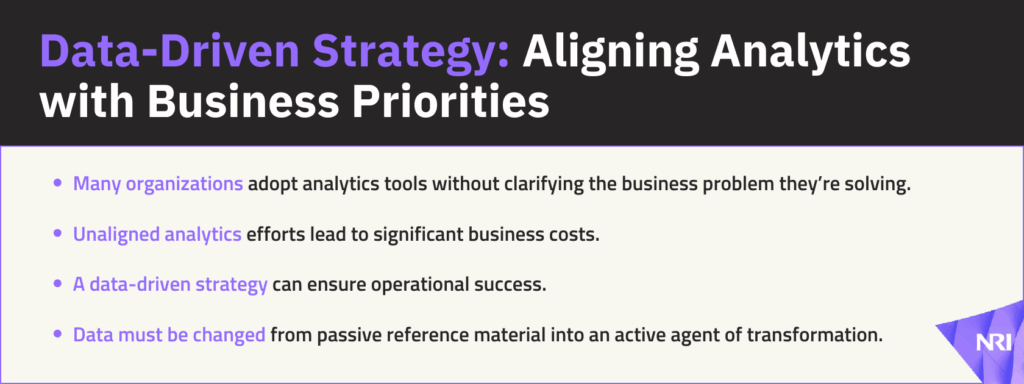
Accumulating lots of data isn’t difficult with today’s tools. But leveraging it in a way that supports business strategy and success is where the real challenge lies.
The organizations that lead in this area are those that utilize their data with intention and skill, transforming analytics into strategic assets rather than merely operational tools.
Investing in analytics that don’t align with business goals can lead to wasted spending, conflicting KPIs, and decisions that don’t support where an organization wants to go. Organizations armed with poor insights can also miss out on business opportunities and fall victim to operational inefficiencies.
However, using a data-driven strategy that aligns analytics with business priorities allows leaders to plan effectively for their next moves, anticipate and resolve recurring issues, optimize performance across different functions, and operate confidently in fast-paced environments.
NRI Turns Simple Data into Real Intelligence
NRI works with clients to avoid the pitfalls of misused data and to utilize properly aligned analytics and a data-driven strategy, ensuring they address real business questions. We help them validate data integrity and create strategy-led roadmaps that turn simple information into real intelligence.
Take, for example, a family-owned car dealership whose analytics platform struggled to keep pace with its expanding operations. NRI helped the dealership consolidate its scattered data, implement a far more powerful analytics platform, and streamline data pipelines to reduce latency and eliminate inefficiencies. The net result was a 50% cost savings and a 10x performance boost.
The Disconnect: When Data Lacks Direction
The problem that many organizations face is that they don’t adopt an effective data-driven strategy from the outset. They put the cart before the horse, building data platforms before they clarify the problems that they need to solve.
Starting with technology before establishing business objectives can lead to analytics that are descriptive, rather than prescriptive, and can be misleading and even harmful. This can result in:
- Misaligned KPIs that reinforce the wrong behaviors
- Redundant or siloed reporting across business units
- A lack of actionable insights due to “dashboard overload”
IBM writer Tim Mucci points out that proper data-driven decision-making is a necessity: [It] is an approach that emphasizes using data and analysis instead of intuition to inform business decisions. “It involves leveraging data sources, such as customer feedback, market trends, and financial data, to guide the decision-making process. By collecting, analyzing, and interpreting data, organizations can make better decisions….”
The approach can help businesses to:
- Improve customer satisfaction and engagement
- Reduce churn
- Implement more proactive business practices
- Take advantage of growth opportunities
- And much more
What Happens When Analytics Aren’t Aligned
Even with sophisticated analytic tools, a company can be data-rich but insight-poor. This can undermine effective decision-making and even lead to strategy paralysis.
Other pitfalls can include increased costs, alienated customers, and inefficient processes that are missed or misdiagnosed. As well, critical cross-functional patterns can be overlooked. For example, a company might have a lot of data on a rise in worker accidents, indicating which types of accidents are occurring, when they are happening, and the resulting injuries. However, without a more profound understanding of this information, the analytics may not reveal the crucial role that HR training plays in creating a safe work environment.
Building a Business-Driven Analytics Strategy
At NRI, we believe that innovation starts with intention. To strategize with a client, we start with business questions, not data tools. Working hand-in-hand with our customers, we reverse-engineer the analytics roadmap based on what the client needs to know to be competitive and scale up.
We reverse-engineer the analytics roadmap based on what the organization needs to know to compete and grow, as well as what data supports this knowledge. We also determine the metrics that need to be used to measure business health and the company’s progress towards clearly defined goals.
NRI takes the time to understand your organization’s big picture, to get a holistic view of your business and the value it provides. To unlock the value and to thoroughly understand the risks and opportunities, we have a defined and successful process in place that includes:
- SIPOC (suppliers, inputs, process, outputs, customers) analysis to map the data flow from source to outcome
- Capability models to identify functional maturity
- A functional decomposition to spot gaps in data collection or context
We utilize visual tools to effectively present a company’s technological strategy and roadmap, ensuring that everyone is aware of the business’s direction.
And NRI provides real value, replacing vanity metrics with performance-driving KPIs. If a data platform upgrade is required, we ensure that it supports the business strategy.
In some cases, the approach takes the client in unexpected but welcome directions. For example, we collaborated with the New York Blood Center to develop a comprehensive strategy and roadmap. The client thought they had two or three problems to fix, but the process revealed 137 opportunities for improvement. These boiled down to 60 projects that the Blood Center could undertake to significantly improve its operations significantly.
Why Organizations Choose NRI
While some technology consultants and partners simply implement dashboards, NRI creates alignment, uncovering hidden inefficiencies and strategic blind spots. We work to connect executive visions with frontline metrics, enabling better decision-making by asking the right questions.
We know that analytics alone won’t solve real business problems. In fact, they can be an unwelcome distraction.
With NRI’s proven methodology, companies can transform analytics from fragmented reporting into a precision machine that drives growth. Your drive to growth and success can begin by connecting with one of our technology solutions clients. You’ll soon unlock the power of data that aligns with your business vision.