
Transform legacy infrastructure into a scalable, AI-ready ecosystem that drives agility, security, and lasting business value.
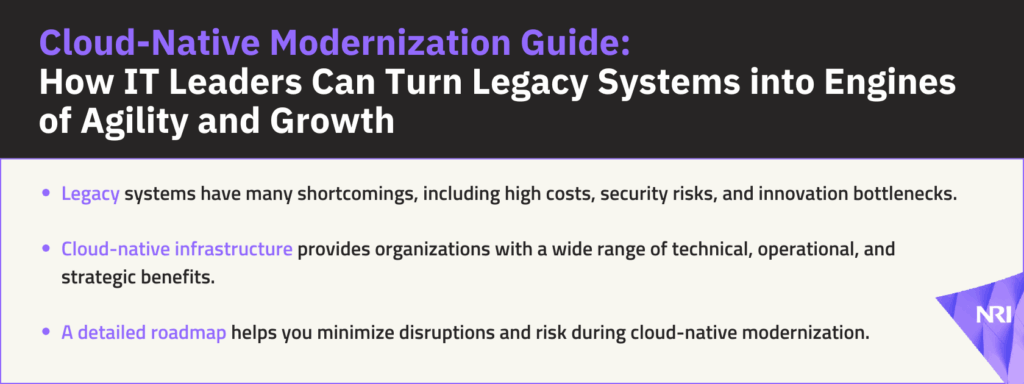
For decades, enterprises have relied on legacy systems for their operations. They were once symbols of reliability and control. However, in an era defined by speed, scale, and continuous innovation, those same systems are no longer enough. The modern enterprise runs on flexibility, and that is what cloud-native infrastructure delivers.
Cloud-native modernization enables organizations to move faster, integrate AI seamlessly, and adapt to change without disruption. It replaces static, maintenance-heavy systems with agile, scalable environments built for continuous evolution.
In this article, you will learn how to assess your organization’s readiness for modernization, design a roadmap that balances ambition with stability, and manage the cultural and security challenges that come with this transformation.
Assessing where you stand
A successful legacy to cloud-native transition begins with clarity. In other words, before you shift from legacy to cloud-native systems, you must have a clear understanding of where you stand. Assess your current environment, including systems, dependencies, and business drivers.
- Evaluate legacy workloads and dependencies.
Start by identifying all applications that depend on your existing infrastructure. Determine which ones deliver measurable business value and which consume resources without a sufficient return. Many legacy systems have been patched and expanded over the years, creating hidden dependencies that can disrupt migration. Mapping them helps you plan a structured transition later.
- Assess readiness for identity migration.
Next, review your readiness to migrate identity systems, including user accounts, credentials, access controls, and authentication methods. In a cloud-native environment, identity is the first line of defense. Properly managed identity systems keep data secure and access controlled across locations and devices. Poorly managed ones become a single point of failure.
- Clarify your business drivers.
Technology alone does not define the success of modernization. The transformation should serve clear business goals such as improved customer experience, cost optimization, or faster innovation. Knowing the “why” behind modernization keeps teams aligned and ensures that resources go toward outcomes that create measurable impact.
Building a roadmap for modernization
The next step after assessing your current position is to design a comprehensive modernization roadmap. A modernization roadmap translates strategy into execution. It allows you to move from assessment to action without overwhelming your teams or disrupting operations. The most effective roadmaps combine clear priorities with a phased approach that builds confidence along the way.
- Prioritize the right applications.
Not every system needs to move at once. Start with high-value applications that can immediately benefit from the scalability and intelligence of cloud-native platforms. Customer-facing systems, such as CRM or ERP platforms, are good starting points because improvements in these areas quickly enhance visibility, collaboration, and decision-making.
By prioritizing high-impact applications and embedding artificial intelligence, you transform modernization from a technical exercise into a strategic advantage.
- Adopt a phased approach.
Plan migrations in manageable phases. Start with less complex systems that deliver quick results, then move to mission-critical applications as your infrastructure and team maturity increase. Phased modernization reduces downtime, limits disruption, and ensures each step strengthens the foundation for the next.
- Design with identity at the core
An identity-first approach should guide every stage of modernization. This ensures users and systems always have the right level of access and that security policies are consistent across environments. Strong identity management enhances operational efficiency, streamlines compliance, and accelerates the adoption of new cloud-native capabilities.
Managing risk, security, and culture
Technology transformation is only part of the journey. Successful modernization depends equally on managing risk, securing systems, and guiding people through change.
- Make identity migration the first step toward Zero Trust.
Migrating identity systems sets the stage for a Zero Trust architecture, where every access request is verified, authorized, and continuously monitored.
Research from Zscaler shows that organizations combining Zero Trust with strong cybersecurity hygiene can reduce losses from cyber incidents by more than 30%. The combo of security and data cleanliness makes identity migration not just a technical task, but a strategic foundation for resilience.
- Adoption & change management
For cloud-native transformation to yield the desired effect, people must embrace it. Your organization’s employees must be willing to let go of old habits and switch to new systems. To facilitate that, develop a change management plan before migration.
It should include early engagement, training, and continuous communication. Then share the reasons why your organization needs to shift from legacy to cloud-native systems, including improving workflows, creating growth opportunities, and reducing friction.
- Implement governance frameworks to reduce disruption.
Cloud-native systems rely on microservices, APIs, and distributed architectures, which increase flexibility but expand the attack surface. A strong governance framework ensures stability as your environment grows more complex. Establish clear policies for deployment, access, compliance, and incident response to ensure a consistent approach across all teams. Reinforce them through regular audits, performance monitoring, and continuous improvement.
From Vision to Execution
Cloud-native modernization isn’t exclusively about technological transitions. It’s also about turning your vision into measurable outcomes. Moving beyond legacy systems enables the agility and intelligence necessary to innovate more quickly, enhance security, and thrive in a digital economy that values adaptability and innovation. Modernization connects people, data, and systems in ways that allow organizations to scale ideas into impact.
The companies that act now will define the standard for enterprise performance over the next decade. By combining a clear roadmap with the right expertise, modernization becomes a strategic advantage. NRI partners with organizations to turn this transformation into measurable growth, helping them build a foundation that is ready for what comes next.
Contact us today to discover how we can support your transformation journey.