
Treating application modernization and business transformation as a one-time project can stall progress, leaving systems rigid and disconnected from evolving business demands. Here’s why building modernization as a continuous capability drives agility, innovation, and measurable outcomes.
According to a report by the Enterprise Risk Management Academy, 70% of digital transformation initiatives often stall or spiral out of control.
However, the root cause is rarely a lack of vision or funding. More often, transformation slows because legacy systems lack the design for today’s speed, scale, and constant change.
Business teams push for faster product launches, real-time insights, and seamless digital experiences. Yet execution struggles under the weight of rigid application architectures that resist iteration and experimentation.
The result is predictable. Transformation programs overrun timelines because applications cannot adapt quickly enough. IT teams, meanwhile, are constrained by tightly coupled systems, brittle integrations, and technical debt that turns even small changes into high-risk initiatives.
This guide explores how application modernization unlocks digital transformation success. It also explains how to reposition modernization as a strategic lever for growth, resilience, and long-term competitive advantage.
Application Modernization as a Business Capability Accelerator
Modernization has moved far beyond patching legacy systems or reducing technical debt. It now sits at the center of how organizations scale innovation, respond to disruption, and deliver measurable business outcomes.
At its core, application modernization enables three critical capabilities that drive measurable business outcomes:
- Business agility
With modernized applications, you can run rapid experiments without worrying about breaking existing systems. You test new ideas, check assumptions, and measure results quickly.
This lets you respond to market opportunities and challenges more quickly. Your strategy actually turns into action, and you move with minimal delay.
- Customer-centric design
Modernization also helps you put your customers at the center of everything you do. An API-first approach makes sure your systems connect and work smoothly across platforms.
You can build composable experiences, assembling and adjusting digital capabilities as customer expectations change. This way, your products and services stay relevant and deliver real value to the people who use them.
- Time-to-market acceleration
Modernization speeds up your time-to-market. CI/CD pipelines make it easier to move features from development to production. Microservices let you update individual components without affecting the rest of your system.
Plus, reusing platforms reduces redundant work and boosts efficiency. The result? You launch products faster and keep your release cycles short and consistent.
Why Cloud-First Doesn’t Automatically Mean Modern
Many organizations assume that cloud migration is the same as modernizing their applications. The danger is treating modernization as a one-time program (single migration or upgrade) rather than a continuous strategy.
Without rethinking architecture, processes, and design, cloud-first initiatives can leave you with the same rigid systems in a new location and force costly rework down the line. This is where platform thinking makes the difference.
Instead of relying on fragmented point solutions that solve only one problem at a time, a platform-based approach connects systems, enables reuse, and supports agility across the organization.
Modernization should be a continuous business capability rather than a one-off project. It should evolve alongside your business needs. It must adapt as markets change, customer expectations grow, and technology advances.
The Business Payoff of Continuous Modernization
Statistics show that companies adopting a digital-first strategy are 64% more likely to outperform their peers across critical business areas. These advantages show up in several key areas that directly impact business performance and competitiveness:
- Superior customer experience
Modernized applications let you deliver seamless, personalized, and responsive digital experiences. Your systems connect across channels and integrate customer data, so interactions stay consistent. Customers notice fewer disruptions, faster responses, and services that feel built just for them, which builds loyalty and keeps them coming back.
- Faster time to market
With modern architectures, you can launch new products and features faster. Continuous integration and delivery pipelines, along with microservices, let your teams deploy updates safely and efficiently. Shorter release cycles mean you capture opportunities quickly, respond to competitors, and stay ahead of the market.
- Greater innovation
Modernization gives your teams the freedom to try new ideas without risking core operations. Modular systems and reusable platforms give you the flexibility to explore creative solutions and test new business models. You can roll out new capabilities more often, creating a culture of innovation that keeps your organization competitive.
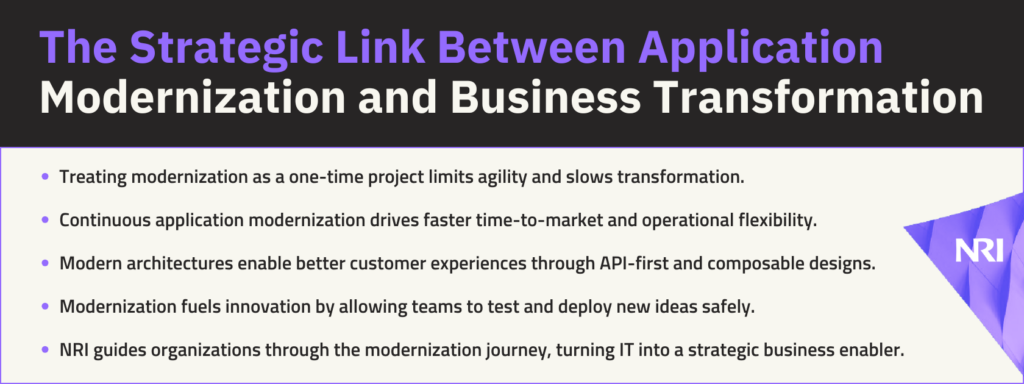
When you treat modernization as a continuous capability, IT stops being just a support function. Instead, it becomes a true strategic enabler, helping you improve customer experiences, accelerate delivery, and drive innovation.
How NRI Drives Value Through Modernization
At NRI, we don’t just move applications to the cloud. We help you transform your business by aligning modernization with your strategic goals. Our approach focuses on delivering measurable outcomes, not just completing technical projects.
Here are the key ways we deliver value and make modernization a true business advantage:
- Strategic assessment aligned to business KPIs
Every successful modernization effort begins with a clear understanding of business objectives and measurable outcomes. Through structured assessments, our team works closely with stakeholders to define the KPIs that matter most and identify gaps between current application capabilities and future needs. This approach ensures modernization initiatives directly support performance, growth, and competitive advantage.
- Platform-centric modernization, not lift-and-shift
Legacy migration alone rarely eliminates complexity or enables long-term agility. Instead of simple lift-and-shift strategies, we focus on platform-centric modernization that builds reusable, connected, and scalable foundations. With this approach, NRI helps reduce fragmentation, improve flexibility, and enable consistent delivery across the enterprise.
- AI-Driven automation for intelligent transformation
Sustainable transformation requires intelligence built into the process. By leveraging Intelligent Data and AI, we automate key workflows, surface inefficiencies, and provide actionable insights that guide smarter decisions. Through this method, our team ensures modernization becomes continuous, repeatable, and aligned with evolving business priorities rather than a one-time technical upgrade.
Turn Modernization Into Business Value With NRI
Business transformation doesn’t start with technology choices. It starts with rethinking how applications enable your business to evolve. You should reconsider your application strategy and treat modernization as a strategic enabler rather than a technical exercise.
If you want a partner to guide you through the modernization journey, NRI is here to help. We can connect application evolution directly to your business outcomes, align IT with your strategic goals, and create a roadmap that drives agility and measurable growth.
Ready to take the next step in turning IT into a true business accelerator? Schedule an executive briefing with NRI to explore how your application strategy can align directly with your transformation goals.