
Before you trust AI with decisions, determine who owns the outcomes.
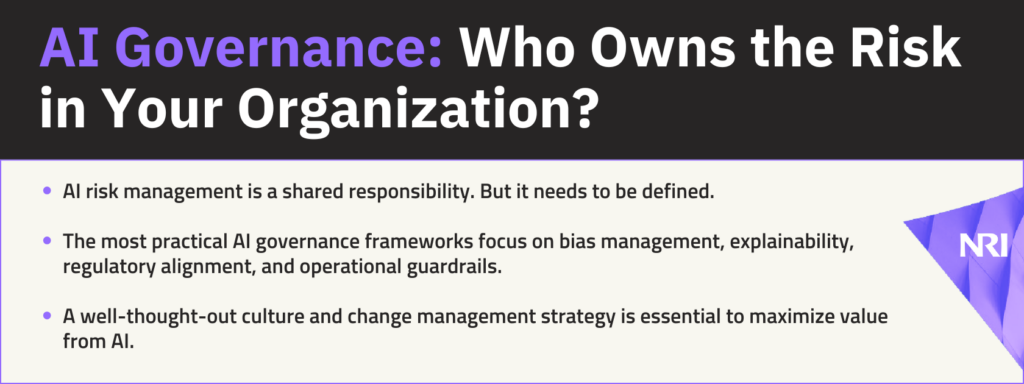
AI is officially a board-level topic. It’s on quarterly agendas, embedded in strategy decks, and woven into digital-transformation roadmaps. Yet in most enterprises, the moment you ask, “Who owns AI governance?” the room gets quiet.
IT thinks governance sits with compliance. Compliance thinks it belongs to the business. The business department assumes IT is on top of it. And in many organizations, ownership floats in a gray area where responsibility is implied, but not defined.
This quiet ambiguity is exactly how risk grows.
When ownership is undefined, bias slips through unchecked. Access expands unintentionally. Regulatory exposure grows. And the real promise of AI (smarter decisions, faster workflows, new value creation) gets overshadowed by uncertainty. Therefore, it’s essential to bridge the accountability gap through a well-thought-out AI governance strategy.
Why AI Raises New Governance Questions
Traditional IT governance frameworks were built for systems that behaved predictably. AI does not. Models shift as data shifts. Outputs vary. Interpretability is often limited. And decision-making logic is increasingly embedded inside applications, not layered on top.
This introduces new categories of enterprise risk:
- Bias emerges from uneven or legacy datasets.
- Explainability gaps make it hard to justify decisions to regulators, customers, or even internal stakeholders.
- Security vulnerabilities emerge, especially when AI models sit adjacent to highly sensitive data.
- Regulatory uncertainty also arises as global frameworks (the EU AI Act, NIST, state-level rules) evolve faster than enterprises can adapt.
In modernization initiatives, these risks can compound quickly. So, as AI becomes woven into APIs, workflows, and business processes, governance can’t be an add-on; it must be architectural.
Clarifying Ownership and Accountability
The right answer to “who owns AI risk?” is: no single function.
Governance must be cross-functional and role-based.
The practical architecture of forward-thinking enterprises includes three clear owners:
- Executive leadership sets strategy, risk appetite, and ensures governance parity with other enterprise risks.
- IT leaders operationalize model management, secure model access, manage data pipelines, and enable responsible experimentation.
- The compliance and risk department defines policy guardrails, reporting, and remediation workflows, and holds teams accountable to applicable standards.
IT leaders are uniquely positioned to be the connective tissue that facilitates innovation while safeguarding data, identity, and access.
Solid identity migration ensures only approved users, services, and CI/CD pipelines can access models and sensitive data. So that should be a foundational step in all AI governance programs. It’s a technical control that directly maps to accountability.
Building Practical Governance Frameworks
A pragmatic AI governance framework focuses on a few non-negotiables:
- Bias Management: Treat bias proactively, not reactively. Integrate recurring audits into the model lifecycle, incorporate diverse training data, and track fairness metrics aligned with each use case’s risk profile.
- Explainability: Not every model needs the same level of explainability, but every decision-making model must be justifiable for its use case. Traceability from input data to the AI model to its output is essential.
- Regulatory Alignment: Use global frameworks as your north star. For instance, if you operate in Europe, the EU AI Act offers a clear blueprint for risk-tier mapping, documentation requirements, and governance obligations. Similarly, NIST provides a complementary structure for technical controls and operational checkpoints here in the U.S.
- Operational Guardrails: Role-based access. Versioned model registries. Deployment gates. Continuous monitoring. None of this is glamorous, but it’s the glue that holds AI governance together.
NRI can help your enterprise implement AI governance that supports agility, not restricts it. Frameworks that scale. Policies that guide without blocking innovation. Tooling that enforces standards automatically.
Embedding Governance in AI-Enabled Modernization
As organizations modernize their applications, AI becomes increasingly embedded in core operations. This requires a shift. Governance must be designed into the build process, not stapled on after deployment.
Consider embedding governance at these touchpoints:
- Architecture reviews: include privacy, explainability, and model-risk criteria from the start.
- Data lineage mapping: understand where data originates, who owns it, and how it flows.
- CI/CD pipelines: integrate governance gates directly into the deployment process.
- Production monitoring: continuously track drift, fairness, performance, and compliance.
Think of it like DevSecOps, but for AI risk. Governance and modernization must move together.
Culture and Change Management
Even the best controls fail if culture isn’t aligned.
Always remember that, at the end of the day, the shift you’re asking your organization to make isn’t just technical, it’s behavioral.
So, position AI governance as an enabler. Not a blocker, not a slowdown, but a safeguard that actually accelerates responsible adoption.
Train business users. They don’t need to understand all the technical details about your AI models, but they need to understand judgment thresholds, escalation procedures, and the limits of AI recommendations.
Also, don’t skimp on securing executive sponsorship. Remember, when leaders take AI governance seriously, the rest of the organization will, too.
Finally, embed governance into daily workflows. Make compliance the default path, not the extra step.
Turning Governance Into Competitive Advantage
If you want a practical starting point, here’s a simple, high-impact roadmap:
- Modernize identity and access management for models and high-risk datasets.
- Define a governance council with clear charters, KPIs, and decision rights.
- Create an AI inventory documenting all models, data sources, risk tiers, and owners.
- Implement lifecycle monitoring for drift, fairness, and compliance metrics.
- Align to a relevant framework like the NIST or EU AI Act.
Make sure someone takes ownership, and that ownership is visible.
Get Expert Help With AI Governance From NRI
AI governance is more than a policy or a framework. It’s enterprise risk management for the next decade. The organizations that define ownership now won’t just reduce risk, they’ll accelerate innovation. They’ll build trust with regulators and customers. And ultimately, they’ll unlock far more business value than those who treat governance as an afterthought.
So the question is: will you be among the front runners?
NRI can help you develop an AI governance strategy that covers all bases, so you can maximize value from your AI initiatives without unnecessary exposure. Start the conversation to learn how to thrive in this new AI era.