
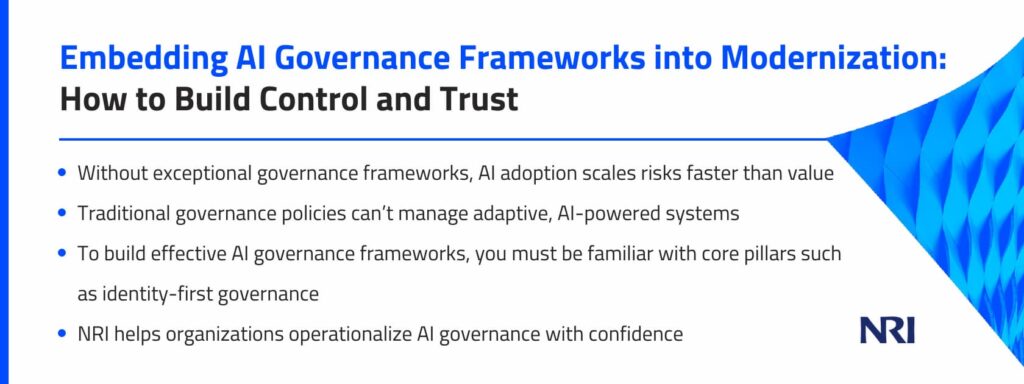
AI governance frameworks must be part of every AI-driven modernization effort. Without integrated governance, modernization can amplify risk faster than value.
A few years ago, AI was just a pilot experiment that only a few companies were willing to explore. Now it has become a core part of business strategy, driving automation, analytics, and decision-making across nearly every industry. A 2025 McKinsey survey found that 78% of global organizations already use AI to enhance efficiency and competitiveness.
But with the skyrocketing adoption rate, governance remains a serious challenge. Many organizations are building and deploying AI systems without the necessary policies and structures to manage them effectively. What began as innovation is now becoming a major source of risk, especially when accountability is uncertain and ethical safeguards are weak.
This growing gap between rapid adoption and effective oversight defines the governance challenge facing IT leaders today. Contrary to common belief, robust governance is not about restricting progress but about ensuring AI can advance safely, responsibly, and in alignment with organizational values. This article explains how IT directors can build a governance framework that supports innovation while maintaining control and trust.
Why traditional governance falls short
Many organizations already have governance frameworks that cover data protection, compliance, and risk management. The problem is that most of these frameworks were never designed for artificial intelligence. They were built for predictable systems with structured data, fixed workflows, and clearly defined lines of accountability.
AI works differently. It is adaptive, data-driven, and capable of making autonomous decisions that change over time. Conventional frameworks are unable to account for these dynamics.
They fall short in areas such as detecting algorithmic bias, maintaining continuous oversight, and assigning accountability for machine-led outcomes. Frameworks designed for manual processes cannot keep pace with the scale, speed, and complexity of AI operations.
Organizations integrating AI into their systems must therefore rethink governance entirely. AI-enabled modernization introduces new categories of risk that existing policies cannot address. The most pressing challenges include:
- Opaque models: Many AI systems, especially those built on machine learning and deep learning, operate like “black boxes.” Even their creators may not fully understand how inputs are transformed into outputs. This lack of visibility makes it difficult to detect errors or conduct audits without specialized governance tools.
- Ethical challenges: AI models learn from historical data, which can contain hidden biases. If these biases are left unchecked, they can be amplified, leading to unfair or discriminatory outcomes. Ethical oversight is crucial to ensure that AI systems remain fair and aligned with an organization’s values.
- Inconsistent policies: Governance in most organizations is fragmented. When AI is deployed across departments, inconsistent practices often emerge. One team may apply open access to data, while another enforces strict controls. These inconsistencies make it difficult to maintain accountability, protect sensitive information, and apply governance uniformly.
Traditional governance frameworks were not built for the age of AI. Addressing this gap requires new models that emphasize transparency, continuous monitoring, and ethical accountability throughout the entire design-to-deployment process.
Core pillars of AI governance
Fully leveraging AI and closing the governance gap requires a framework built on three foundational pillars: identity-first governance, ethical alignment, and responsible scaling.
- Identity-first governance
Effective control starts with knowing exactly who and what has access to AI models and data.
This includes both human users and non-human entities such as applications, software agents, and bots. Identity-first governance treats every user or system that interacts with AI as an identity that must be verified, monitored, and authorized.
Enforcing strict access control prevents unauthorized use, protects sensitive data, and ensures that only qualified personnel can modify or deploy AI systems. Because AI often connects to critical infrastructure and sensitive datasets, this approach reduces the risk of manipulation, breaches, and other cyber threats.
- Ethical use, compliance alignment, and transparency
Governance also extends beyond technology to the values that guide its use. A sound framework ensures that AI operates ethically, produces reliable results, and complies with evolving laws and internal standards. This pillar is essential because AI-driven decisions can affect people, business operations, and reputation. Without strong ethical guidelines and transparency, organizations face risks such as bias, discrimination claims, penalties, and loss of public trust.
- Guardrails for responsible scaling
AI systems are expanding rapidly across departments and business units, creating new layers of complexity and interdependence. Clear guardrails help organizations manage that growth safely. Monitoring model performance, setting thresholds for automated decisions, and regularly validating outputs keep AI innovation within measurable, accountable limits. These safeguards ensure that scaling AI increases value without amplifying risk.
When these three pillars work together, they form a governance foundation that enables innovation while maintaining oversight, fairness, and trust.
Embedding governance in modernization
AI governance must be an integral part of every modernization effort, as it cannot function effectively in isolation. Well-designed frameworks should be built into initiatives such as cloud migration, intelligent automation, and AI-powered analytics. Without that integration, modernization can quickly become a channel for uncontrolled and risky AI growth.
Reliable AI depends on reliable data. With robust governance frameworks, organizations can effectively track the origin, quality, and flow of data across their systems. This oversight maintains accuracy and reduces the risk of misuse. Data governance also involves enforcing rigorous security controls to safeguard sensitive information and maintain compliance with evolving regulations.
Explainability and auditability should be embedded directly into AI-enabled applications. Explainability enables users and decision-makers to understand how models arrive at their conclusions, thereby improving transparency and trust. Auditability establishes a clear record of decisions and data flows, making it easier to review performance, demonstrate compliance, and assign accountability.
Integrating these elements into modernization ensures that innovation is both responsible and sustainable. When governance and modernization progress together, organizations can scale AI confidently while maintaining control and integrity.
Building trust and control with NRI
Strong AI governance is the bridge between innovation and accountability. It allows organizations to scale AI confidently, knowing that every model, dataset, and decision operates within a framework of transparency, compliance, and ethical integrity. By embedding governance into modernization, IT leaders can turn AI from a fast-moving risk into a reliable engine of sustainable growth.
NRI partners with organizations to build that foundation of trust and control. Our team provides hands-on support in designing and implementing AI governance frameworks that align technology with business goals. Contact us to discover how NRI can help you govern AI with confidence and responsibly realize its full potential.