
In complex mergers, an AI-driven M&A data strategy is the difference between accelerated value creation and unmanaged risk.
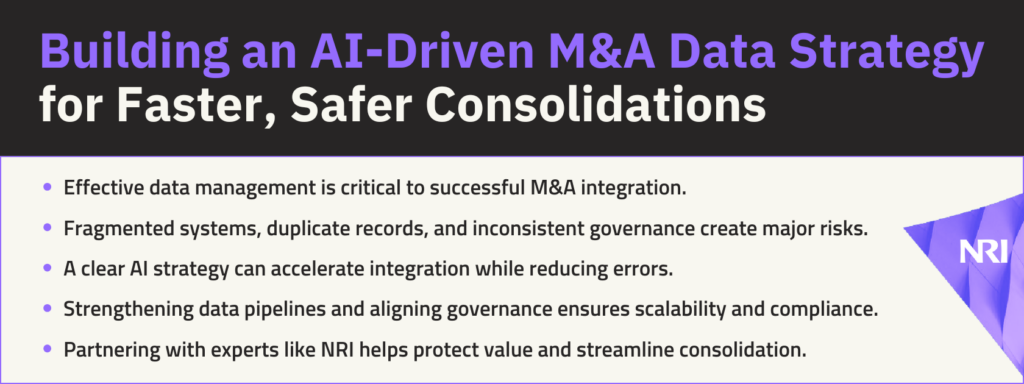
Are you frustrated that your recent merger or acquisition has failed to achieve its expected value? Many organizations face this reality, with studies suggesting that up to 70% of mergers and acquisitions fall short of their original objectives.
Many deals fall short not because of strategy, but because teams cannot combine information, align operations, or gain clear visibility fast enough. When organizations delay efficiency gains or miss growth goals, the problem is often simple. Disconnected systems, inconsistent rules, and unclear data ownership create confusion and slow everything down.
AI raises the stakes. It can accelerate analysis, automate reconciliation, and quickly surface integration gaps. But without a clearly defined AI-driven M&A data strategy, it can also scale inconsistencies, extend flawed data across platforms, and increase exposure across the enterprise.
For IT directors and VPs, this is the inflection point. Consolidation is not just about infrastructure alignment. It is about establishing control over data pipelines, standardizing governance, safeguarding sensitive information, and determining how AI supports integration without introducing unnecessary risk.
Continue reading to see how an AI-driven M&A data strategy helps IT leaders manage complexity, align governance, and guide AI-powered integration with clarity and control.
M&A in the Age of AI: Opportunity and Exposure
Mergers and acquisitions come with several challenges, and data disruption is usually one of the first to surface. When two organizations combine, systems often do not align, records overlap, and internal data rules differ. What looks manageable on paper can quickly become complicated in practice.
Several common issues are usually to blame, such as:
- Fragmented systems: Different departments, regions, or business units often rely on separate tools and platforms. These disconnected systems make it harder to share information and operate as one organization.
- Duplicate records: It’s common to find multiple versions of the same customer, vendor, or operational data. Duplicate records create confusion, reporting inconsistencies, and unnecessary rework.
- Inconsistent governance models: Each company brings its own approach to access control, compliance, and data management. When those models don’t align, accountability becomes unclear and risk increases.
Introducing AI into this mix can help, but it can also complicate things.
AI-powered tools can accelerate analysis, uncover patterns, and support faster decision-making during integration. But if the underlying data is disorganized or governance standards are unclear, AI can just as easily amplify errors and scale risk across the combined enterprise. That’s why an AI-driven M&A data strategy is not optional. It’s foundational.
In the end, the responsibility sits with IT leadership. IT directors and VPs shape data consolidation, governance, and protection throughout integration. The technology matters, but the strategy behind it determines whether consolidation creates value or introduces avoidable exposure.
Establish a Unified Data Strategy Before Integration Accelerates
Before integration gains momentum, a clear data strategy must be in place. Without it, consolidation can move faster than control, increasing the likelihood of reporting errors, security gaps, and compliance missteps that erode deal value.
A disciplined approach early on prevents avoidable setbacks later. Key steps include:
- Data inventory
- Start with a structured inventory across both organizations. Classify critical data assets, understand ownership, and identify where sensitive or regulated data resides. You cannot integrate what you have not fully mapped.
- Identify overlaps
- Look closely at duplicate records, redundant systems, and incompatible architectures. These issues are common in M&A and, if left unresolved, can lead to confusion, inconsistent reporting, and unnecessary operational friction.
- Define the target data model
- Establish a unified data model aligned with your broader M&A IT strategy. This becomes the blueprint for how information is structured, accessed, and governed across the merged enterprise.
- Plan for interoperability
- Prioritize platforms and pipelines that can work together without excessive customization. Integration should support scalability and future growth, not just short-term consolidation.
Combining these steps forms the foundation of a disciplined AI-driven M&A data strategy. When the foundation is clear, integration moves with purpose rather than urgency, protecting enterprise value while reducing exposure.
Align Governance Models to Reduce Compliance and Security Gaps
Strong governance is what keeps integration steady as systems, policies, and compliance requirements overlap. During M&A, misaligned access rules, unclear ownership, and conflicting regulatory standards can introduce risk quickly and quietly. Without deliberate alignment, these gaps slow progress and expose the organization to avoidable liability.
Effective governance alignment starts with standardizing policies across both entities. Access controls, data retention rules, and audit requirements should follow a single, consistent framework so teams operate under the same expectations. Consistency reduces confusion and strengthens accountability.
It also requires reconciling regulatory obligations across industries and geographies. Each organization may operate under different compliance mandates, and those requirements must be reviewed and harmonized before systems are fully integrated. Addressing these differences early prevents compliance conflicts from surfacing after consolidation.
Finally, governance must be anchored in centralized oversight. Clear accountability for data ownership and stewardship ensures decisions are coordinated rather than fragmented. When responsibilities are defined and enforced consistently, governance becomes an enabler of integration rather than an obstacle.
Leverage AI to Accelerate and De-Risk Integration
Artificial Intelligence (AI) can speed up M&A integration while reducing errors and risk. With the right tools, your team can handle large volumes of data efficiently and accurately.
The following are the ways to harness AI for integration success:
- Data mapping
Use AI-driven tools to map data and align schemas across systems ensures information flows correctly between merged platforms.
- Anomaly detection
Deploy AI to spot irregular access or suspicious activity. Early detection helps prevent security breaches and compliance issues.
- Duplicate identification
Apply machine learning to find duplicate records and cleanse data. Cleaning duplicates improves accuracy and reduces wasted effort.
- Automate reconciliation
Automate reconciliation workflows to reduce manual errors. Automation speeds integration and ensures consistent results.
Using AI strategically allows IT directors to accelerate integration, maintain data integrity, and minimize risk. It turns complex M&A data challenges into manageable, actionable processes.
Strengthen Data Pipelines for Scalability and Insight
Robust data pipelines are essential for smooth integration and long-term value after a merger. Strong pipelines reduce delays, improve data quality, and support actionable insights across the organization.
Key steps to strengthen your data pipelines include:
- Consolidate Pipelines
Combine fragmented pipelines to reduce delays and improve efficiency. Unified pipelines make data easier to manage and move between systems.
- Modernize Architecture
Upgrade systems to support real-time analytics after the merger. Modern architecture ensures teams can make faster, data-driven decisions.
- Continuous Quality Monitoring
Monitor data quality continuously rather than in isolated checks. Ongoing monitoring prevents errors from accumulating and impacting business processes.
- Leverage AI for Efficiency
Use AI to optimize pipelines and support operational efficiency. AI can help manage workloads, detect issues, and provide actionable insights faster.
Strengthening data pipelines ensures that integration scales smoothly and supports long-term growth. It allows IT leaders to turn merged data into a strategic asset for the organization.
Secure Your M&A Success with NRI
M&A puts pressure on your data before it delivers value. If systems are misaligned or governance is unclear, integration slows and risk increases. A clear, well-executed AI-driven M&A data strategy keeps consolidation on track and protects what the deal was meant to create.
NRI works alongside IT leaders facing fragmented platforms, overlapping records, and tightening compliance requirements. We help you bring structure to integration through unified data models, aligned governance frameworks, and AI-enabled analysis that supports informed decision-making.
Our role is practical and hands-on. We assess what exists, clarify ownership and accountability, and design scalable data pipelines that support secure post-merger data integration. The goal is clear: accelerate consolidation without losing control.
If your organization is preparing for a merger or already navigating one, now is the time to align your data strategy with your business objectives. Connect with NRI to build an integration plan that supports speed, security, and long-term performance.