
Leverage a structured digital transformation roadmap to align strategy, systems, and execution and turn fragmented digital initiatives into measurable enterprise outcomes.
Technology isn’t slowing down, and neither are the expectations around your business. You’re dealing with constant pressure to move faster, operate more efficiently, and deliver better experiences every time someone interacts with your organization.
That pressure is pushing you toward AI, cloud-first infrastructure, and hybrid work. These shifts are no longer optional. They are how organizations stay competitive and keep up with peers that are already moving faster.
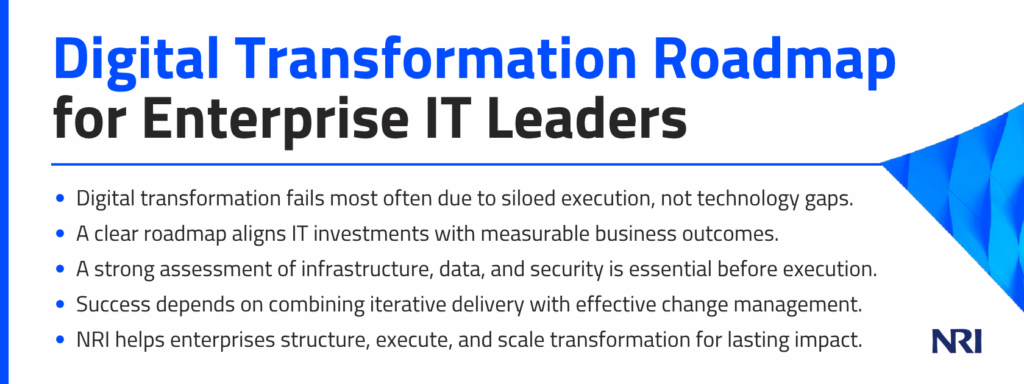
Even so, many transformation efforts fail to deliver real value. The problem usually isn’t the technology. It’s the disconnect between strategy, systems, and execution.
When initiatives move forward without alignment or readiness, they create fragmented data, stalled progress, and fatigue across teams. Research often shows that up to 70% of digital transformation efforts fall short for this reason.
Without a clear foundation, even the most advanced tools remain underused or stuck in pilot mode. What looks like progress on the surface often adds complexity behind the scenes.
This blog post breaks down what a structured digital transformation roadmap looks like and how to use it to drive measurable outcomes.
Assessment and strategic alignment: defining the why before the how
A digital transformation roadmap is a structured plan that guides how you use digital technologies to achieve specific business goals over time. It connects strategy, technology, people, and processes so your initiatives move forward as a coordinated effort rather than in isolation.
Building a roadmap that delivers real value starts with defining the why before the how. What is actually holding your organization back? It could be slow decision-making, fragmented customer data, or operational inefficiencies that create friction across teams.
Skipping this step risks turning transformation into a series of disconnected upgrades. You invest in new tools, but the underlying problems remain. Clear alignment on business priorities ensures every decision you make has a purpose.
Once your priorities are defined, the next step is to assess where you stand today. That starts with a structured review of your current capabilities across three critical areas.
- Existing infrastructure
Take a close look at the systems that support your day-to-day operations. Can your infrastructure handle the speed, scale, and flexibility your business needs, or is it quietly limiting progress?
Outdated or disconnected systems introduce friction at every level. Even the most advanced tools struggle to deliver value when they sit on top of a weak foundation.
- Data maturity
Here, the focus shifts to how effectively you use data across the organization. It is not just about how much data you collect, but whether it is clean, accessible, and trusted.
When data is fragmented or unreliable, decision-making slows down. Strong data maturity allows you to move with confidence, turning insights into action without hesitation.
- Security posture
Security is not just a checkpoint but a continuous measure of how resilient your environment is against evolving threats.
Security assessment looks at risk exposure, compliance gaps, and how well your systems can adapt to modern security demands. A single vulnerability can disrupt operations and erode trust faster than most organizations expect.
Taking the time to assess these areas creates a solid foundation for everything that follows. When you understand where you stand, you can move forward with clarity, not guesswork, and give your transformation a real chance to succeed.
Design and architecture: structuring technology for long-term growth
Once you have clarity on your priorities and current state, the next step is deciding what actually deserves attention first. Not every initiative carries the same weight, and trying to move everything forward at once usually creates more complexity than progress.
Prioritization matters here. Focus on the initiatives that deliver the most impact with the least friction, and be deliberate about what can wait. That discipline keeps your roadmap focused and prevents resources from being spread too thin across low-value efforts.
From there, attention shifts to how your environment is designed. The goal is not just to solve today’s challenges, but to build systems that can support future growth without constant rework.
Scalability, security, and stability need to be part of the architecture from the beginning. When these elements are treated as afterthoughts, they tend to introduce risk and limit flexibility later on. A well-structured architecture gives you room to adapt, integrate new technologies, and respond to change without having to start over.
Execution and change management: managing people and technology shift
With priorities defined and architecture in place, the focus moves to execution. At this point, strategy turns into action, and how you approach it makes a measurable difference in outcomes.
Rather than attempting a full rollout all at once, break the digital transformation roadmap into smaller, iterative milestones. This approach allows you to deliver value incrementally, validate progress along the way, and adjust before issues become difficult to manage. It also keeps momentum steady without overwhelming your teams.
At the same time, successful execution depends just as much on people as it does on technology. New systems alone do not drive change. Adoption does.
That means investing in upskilling, building confidence, and helping teams understand how new tools fit into their day-to-day work. When change is introduced with clarity and support, it becomes part of how your organization operates rather than something it has to work around.
Measurement and optimization: from data to actionable insight
Once your initiatives are in motion, the focus shifts to understanding whether they are actually delivering value or simply creating more activity.
Tracking the right transformation KPIs becomes essential. The goal is to move beyond purely technical metrics and focus on outcomes that reflect real business impact. System uptime and deployment counts still matter, but they do not tell the full story.
What matters more is how those efforts translate into better decisions, improved efficiency, and measurable progress against your goals. Are you prioritizing the right initiatives? Are your investments supporting emerging capabilities, such as AI? Are you seeing meaningful returns within a reasonable timeframe?
When you measure consistently and tie performance back to business outcomes, patterns become clearer. You can identify what is working, where adjustments are needed, and how to refine your roadmap over time.
This is what turns a digital transformation roadmap into a living strategy. Instead of reacting to scattered signals, you gain the clarity to make informed decisions and keep your transformation moving in the right direction.
Drive measurable digital transformation success with NRI
A digital transformation roadmap is not something you set once and leave behind. It evolves as your business, priorities, and environment change, helping you stay aligned between what you plan and what actually happens in practice.
Getting started with digital transformation can feel complex, especially when multiple initiatives, systems, and teams are involved. Having the right structure in place makes a difference, but so does having the right partner to guide how that structure comes together and delivers value.
At NRI, we help you turn broad transformation goals into a clear, executable roadmap. Our approach connects strategy, technology, and measurable outcomes, keeping your initiatives aligned and your teams focused.
Schedule a transformation strategy consultation with NRI to start building a structured digital transformation roadmap that delivers measurable outcomes.