
Leverage focused, practical AI use cases to overcome stalled pilots and drive measurable business value in mid-sized organizations.
According to a recent McKinsey & Company report, 88% of organizations are experimenting with AI, yet 81% report no meaningful bottom-line gains. For IT directors in mid-sized organizations, that gap reflects a familiar tension between ambition and operational reality.
AI may dominate executive conversations, but constrained budgets, lean teams, competing priorities, and limited in-house data science capacity mean that every initiative must demonstrate clear, timely business value. While launching an AI initiative is achievable, turning early experimentation into sustained, measurable impact that can be supported and scaled is far more difficult.
Mid-market organizations cannot absorb large, open-ended transformation programs that require heavy customization, extended timelines, or specialized talent. When projects become overly complex or disconnected from core objectives, they consume resources without delivering proportional returns.
Organizations that see results take a different path, focusing on narrowly defined, high-impact use cases tied directly to cost reduction, efficiency, or risk mitigation.
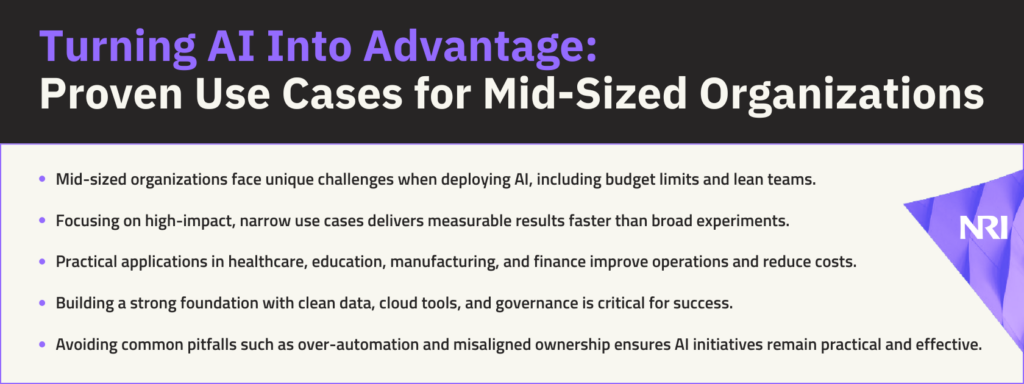
This guide outlines practical AI applications across healthcare, education, manufacturing, and finance, and provides a disciplined approach to delivering measurable value within mid-market constraints.
AI at Mid-Market Scale: A Different Operating Reality
When you lead IT in a mid-sized organization, you operate in a very different environment than a global enterprise. Your AI strategy cannot simply mirror enterprise rollouts for several important reasons:
- Budget constraints
You do not have the flexibility of multi-year innovation budgets or large experimentation funds. Every AI initiative must compete directly with cybersecurity investments, infrastructure upgrades, modernization efforts, and regulatory compliance. That reality requires clear ROI from the beginning, with tightly scoped use cases and predictable costs. Large, open-ended pilots that explore possibilities without defined outcomes are rarely sustainable in this environment.
- Lean teams
Your team likely manages infrastructure, cloud environments, security, and application support, often simultaneously. Adding AI initiatives to that workload means solutions must be operationally manageable from day one. If a deployment requires constant model tuning, specialized oversight, or complex monitoring processes, it can quickly strain limited capacity and slow progress across other priorities.
- Limited in-house data science resources
Unlike large enterprises, you may not have a dedicated data science department focused on advanced model development and optimization. Implementing AI often depends on external partners, embedded platform capabilities, or packaged solutions. As a result, tools must be accessible, well-supported, and designed for practical business implementation rather than experimental research.
Taken together, these constraints create a shared risk. Technically sophisticated solutions promise transformation, but if they exceed your team’s capacity to support and scale them, they become operational burdens rather than strategic assets. In this environment, practical scalability consistently matters more than technical sophistication.
Start with High Impact, Narrow Use Cases
When adopting AI in a mid-sized organization, the most reliable approach is to begin with focused, clearly defined problems that can deliver visible results within a reasonable timeframe. Attempting enterprise-wide transformation too early often spreads resources thin and reduces accountability. Concentrating on a specific operational challenge allows you to prove value quickly, build internal confidence, and create a repeatable model for future expansion.
- 1. Tie AI to business value
Prioritize initiatives directly connected to cost reduction, efficiency gains, or risk mitigation. If a use case cannot demonstrate how it improves margins, reduces downtime, shortens processing cycles, or lowers exposure, it is unlikely to gain sustained executive support. Clear financial or operational impact strengthens business ownership and accelerates decision-making.
- Focus on structured data
Begin in environments where data is already organized and reliable. Financial systems, operational logs, CRM platforms, and transactional records typically provide a strong foundation for early AI deployment.
Working within structured data environments reduces complexity, speeds implementation, and lowers the risk of unexpected setbacks. As capability and confidence grow, you can expand into more advanced or unstructured applications.
- Avoid broad transformation mandates
Sweeping AI programs may sound compelling, but they often stretch budgets and dilute responsibility. Targeted deployments enable disciplined execution, clearer accountability, and faster proof of value. Success in one area creates credibility that supports expansion into others.
- Define measurable success early
Before committing significant resources, establish specific KPIs, timelines, and performance thresholds. Clear success criteria make evaluation objective and allow you to adjust quickly if outcomes fall short of expectations.
In mid-market environments, discipline consistently outperforms ambition. Starting narrow, measuring carefully, and scaling intentionally turns AI into a controlled advantage rather than an operational strain.
AI Applications Delivering Measurable Outcomes Across Industries
AI is proving its value not through bold experiments, but through practical applications that improve day-to-day operations. Across industries, several use cases stand out for consistently delivering operational value rather than experimental ambition.
- Healthcare
In healthcare, AI delivers value by reducing administrative workload and supporting clinical decisions. It helps in areas such as:
- Workflow automation: AI handles claims processing, routes documentation, and enters data. This reduces errors and frees staff to focus on other tasks.
- Patient scheduling optimization: AI balances provider availability, patient demand, and no-shows to improve resource use and reduce wait times.
- Anomaly detection: AI identifies unusual patterns in clinical data, billing, or system activity to flag potential risks.
Focusing on these applications makes AI a practical tool for improving operations, not just an experiment.
- Education
AI streamlines workflows in educational institutions, enabling them to run more efficiently. Institutions can apply AI to address specific operational challenges, such as:
- Enrollment forecasting: AI predicts student enrollment trends, helping schools accurately plan staffing and class capacity.
- Resource allocation: AI determines how to distribute classrooms, faculty, and learning materials to meet demand efficiently.
- Student engagement analytics: AI tracks participation and performance patterns to identify students who need extra support or intervention.
When applied thoughtfully, AI tools can turn complex data into actionable insights that can help educators work smarter, not harder.
- Manufacturing
AI drives real impact in manufacturing by preventing equipment failures, improving quality, and optimizing workflows. Here are the key applications that drive measurable impact:
- Predictive maintenance: AI analyzes machine data to forecast equipment failures. You can schedule maintenance before breakdowns occur.
- Quality inspection: AI checks products for defects and inconsistencies. AI-driven quality control ensures higher quality standards without slowing production.
- Supply chain visibility: AI tracks inventory, shipments, and supplier performance. It helps identify bottlenecks and improve overall supply chain efficiency.
These AI solutions simplify operations and create smarter workflows that keep your production line running at peak performance.
- Finance
Finance teams see measurable results from AI when it increases reliability, shortens processing times, and strengthens oversight. The following are the key applications that produce measurable results:
- Fraud detection: AI scans transactions and accounts to identify suspicious activity, preventing financial losses and protecting clients.
- Credit risk modeling: AI evaluates borrower data to predict the likelihood of default. It supports better lending decisions and reduces risk exposure.
- Intelligent document processing: AI extracts and organizes data from invoices, contracts, and forms. This speeds up workflows and reduces manual errors.
These AI applications turn complex financial tasks into reliable, efficient operations that strengthen both performance and trust.
In each of these sectors, the common thread is clear: the strongest AI impact comes from solving real operational challenges rather than chasing experimental innovation. When you focus on practical applications, AI becomes a tool that strengthens day-to-day operations and drives tangible business outcomes.
Building the Right Foundation with Limited Resources
Getting AI to work in a mid-sized organization starts with laying a strong, practical foundation. You can achieve this even with constrained budgets and lean teams by focusing on key strategies such as:
- Modernizing data pipelines: Ensure data is clean, organized, and easily accessible so AI can deliver reliable results.
- Leveraging cloud-based AI services: Use scalable cloud tools to reduce infrastructure costs and simplify deployment.
- Implementing governance and model monitoring: Establish oversight from the start to maintain compliance, track performance, and avoid surprises.
- Upskilling IT teams: Train existing staff to manage AI solutions effectively without the need to expand headcount significantly.
Focusing on these foundational steps ensures that AI initiatives run smoothly, remain manageable, and generate consistent operational value from the very beginning.
Avoiding Common Pitfalls in Practical AI Deployment
Deploying AI successfully requires more than just choosing the right tools. It demands careful planning and awareness of common mistakes, such as:
- Data prep gaps: Underestimating data preparation requirements can lead to inaccurate models and wasted effort.
- Over-automation: Relying entirely on AI without human oversight can create errors or missed context.
- Change management lapses: Ignoring user adoption and training can prevent AI from being used effectively.
- Misaligned ownership: Failing to align AI initiatives with business ownership and accountability can cause AI initiatives to drift and fail to deliver results.
Avoiding these pitfalls ensures your AI projects remain practical, manageable, and focused on delivering real operational value.
Partner with NRI for Practical AI Success
AI success in mid-sized organizations is not about scale for its own sake. It is about focused deployment, measurable outcomes, and solutions your team can realistically support. Recent data shows organizations using AI effectively have achieved up to a 50% improvement in product performance and a 26% reduction in operational costs, proving that disciplined execution delivers real results.
NRI helps IT leaders translate strategy into practical, scalable implementation. With experience across governance, data foundations, and targeted use cases, the focus remains on measurable value rather than unnecessary complexity.
If you are ready to move beyond experimentation and build AI initiatives that fit your operating reality, NRI can help you define a strategy that delivers sustained impact. Contact us today to get started.