
With more projects than capacity, IT leaders must master prioritization or risk strategic drift. Here’s how to ensure the initiatives that truly matter receive the most attention.
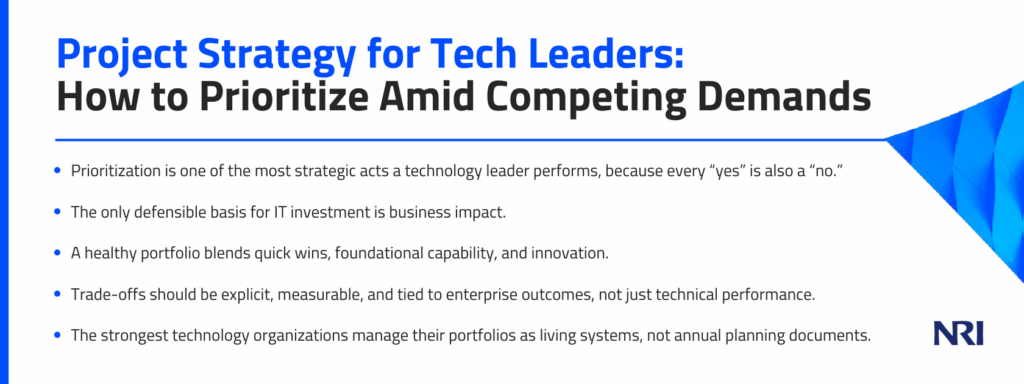
Talk to any CIO or CTO today, and you’ll hear the same tension: the list of priorities keeps growing, but capacity does not.
AI initiatives are accelerating. Cyber threats are intensifying. Modernization is overdue. Business leaders want faster innovation. Boards want measurable returns. Every initiative sounds important. Many truly are.
But here’s the reality: without disciplined prioritization, even the best technology strategy collapses under its own ambition. The result is strained resources, missed deadlines, and diluted impact.
A strong project management office (PMO) may provide structure, visibility, and governance. But the real differentiator is leadership clarity. Someone must define the criteria. Someone must force the trade-offs. Someone must articulate why certain initiatives move forward, and others wait.
That “someone” is you.
This article offers a structured approach to balancing quick wins, foundational investments, and high-visibility initiatives, while navigating shifting executive priorities.
By the end, you will have a practical framework for portfolio planning, trade-off analysis, and value-based decision-making to support both agility and accountability. Keep reading.
Anchor the Portfolio to Strategy First
Start by translating the enterprise strategy into measurable IT objectives.
Audit your current portfolio and categorize initiatives into these four baskets:
- Growth: Projects that drive revenue expansion or unlock new markets
- Efficiency: Projects that cut costs or eliminate manual work.
- Risk mitigation: Projects that harden security, close compliance gaps, or strengthen resilience.
- Innovation: Projects that build competitive advantage or enable new capabilities.
If an initiative does not map directly to these defined business outcomes, remove it from your portfolio. This alignment should be the first filter. Before debating complexity or cost, confirm that the initiative clearly advances the organization’s strategic intent.
Balance Quick Wins, Foundations, and Flagship Initiatives
It’s essential that you maintain a healthy portfolio mix that supports both agility and stability. That includes:
- Quick Wins: Initiatives that deliver visible value relatively quickly, helping build momentum and short-term credibility.
- Foundational Investments: Initiatives that keep the organization healthy. Think infrastructure, security, and architecture modernization. These projects aren’t glamorous. But they reduce technical debt, improve reliability, and enable future capabilities. Without them, your organization gradually becomes fragile.
- Flagship Initiatives: Executive-sponsored programs that cut across functions and deliver transformational impact. These are your most visible efforts and typically consume the most resources.
As you balance your IT portfolio, avoid the trap of over-indexing on urgency at the expense of long-term value.
Introduce Structured Trade-Off Analysis
Once you’ve aligned projects to strategy and balanced your portfolio, the next critical step is a thorough trade-off analysis.
As IT has evolved over the years, so should your metrics. Don’t focus solely on operational metrics such as mean time to resolution (MTTR), ticket volume, and uptime. Go a step further and measure metrics executives actually care about, such as time-to-value, reduction in manual effort, process cycle time improvement, and compliance risks closed.
Evaluate every project against these four criteria:
- Strategic Alignment: Does it advance your defined business objectives?
- Expected ROI: What’s the revenue benefit, cost savings, or strategic value?
- Risk Exposure: What risks does it mitigate, and what risks might it create?
- Capacity Impact: How much of your team’s productive capacity does it consume, and what work becomes impossible if we commit?
Quantify opportunity costs and resource constraints transparently, and ensure your IT strategy accounts for shifting executive priorities. Communicate what will not be done, and why. If, for instance, you’re deferring Project X because you don’t have capacity to focus on Project Y, which has a higher strategic impact, state it explicitly and document the decision framework. Don’t let projects languish in a queue with no explanation. Transparency builds trust. It also creates accountability.
Make It a Living Process
Your strategy might not change every quarter, but business conditions do. Avoiding chaos is an imperative. So build prioritization as a living process, not a one-time event. Establish recurring portfolio reviews. Monthly check-ins for operational health. Quarterly reviews for strategic reprioritization. Bring your leadership team and key executive stakeholders.
In these reviews, ask hard questions. Are projects delivering the value we expected? Which ones are consuming more effort than anticipated? What’s changed in the business that should affect how we’re allocating resources? Based on those answers, adjust. Maybe you reprioritize. Maybe you kill a project. Maybe you accelerate another.
The point isn’t rigidity. It’s disciplined flexibility. You should adapt when conditions warrant it. But adapt intentionally without losing sight of what truly matters. If leadership wants to drop an initiative to focus on something else, communicate the trade-off. Is it worth deferring this work for that work? Your stakeholders should make that decision with full information.
And build a culture where saying no is a strength, not a weakness. Your teams should view prioritization not as a failure to say yes to everything, but as a disciplined choice to focus where it matters most. That mindset shift transforms how people experience their work. They’re no longer juggling impossible demands but focused on delivering real impact.
Start Prioritizing What Truly Matters
Remember, what separates organizations that successfully scale their initiatives from those that don’t is prioritization. They’re not necessarily smarter or better resourced. They’re just disciplined about what they choose to do.
If you anchor every decision to strategy, balance your portfolio across quick wins, foundations, and flagships, and keep your priorities transparent and adaptive, you’ll move faster and deliver more impact.
Need help with project strategy? Schedule a custom consultation to discover how NRI experts can help you prioritize what truly matters.