
Healthcare mergers often struggle when systems and workflows remain disconnected. Here’s how a strong IT Strategy for Healthcare M&A can unify technology, streamline operations, and accelerate better care delivery.
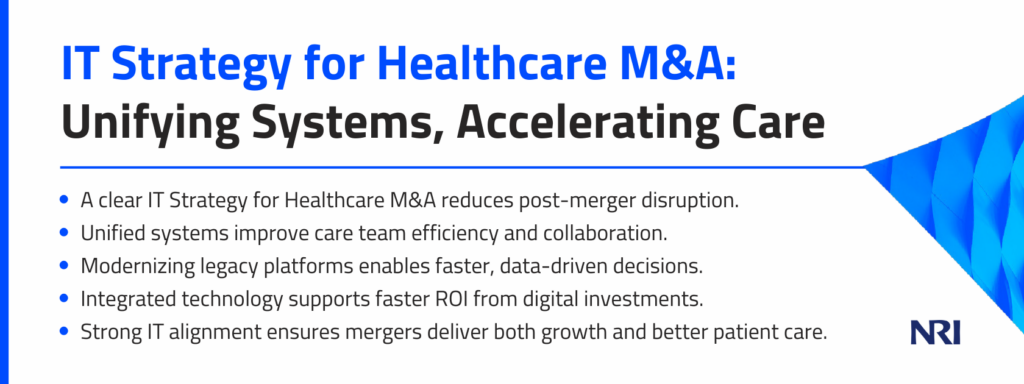
Healthcare mergers are often positioned as opportunities to modernize systems, unify data, and scale operations through digital transformation. Yet many organizations struggle to translate that promise into execution.
According to the American College of Surgeons, only about one in five healthcare integrations leads to improved value in healthcare delivery. The absence of a clear and realistic IT integration strategy that aligns priorities with operational and business objectives drives this gap.
Without that alignment, post-merger efforts tend to focus on consolidating infrastructure rather than unifying how information, workflows, and decisions move across the organization. Data remains fragmented across legacy platforms, workflows differ across entities, and teams are left to navigate disconnected systems while trying to maintain performance and continuity.
Often introduced during a merger, these challenges limit the effectiveness of AI, analytics, and automation initiatives. When addressed in isolation, data governance, application integration, and workflow design stall digital transformation, and the intended benefits of scale remain out of reach.
This article outlines how a clear IT strategy can align data, platforms, and workflows to support successful healthcare M&A.
The Core Challenges Behind Healthcare M&A IT Failures
Healthcare mergers often reveal technology gaps that are difficult to address once systems, people, and processes are expected to operate as a single organization. As integration begins, these gaps strain teams and slow progress across both clinical and administrative functions.
Several recurring challenges contribute to IT failures in healthcare M&A.
- Application sprawl and workflow overload: Mergers frequently bring together multiple tools that serve the same purpose across different departments or entities. This overlap increases complexity, forces staff to switch between systems, and slows daily work instead of streamlining it.
- Shadow IT and aging platforms: When core systems do not meet operational needs, teams turn to unofficial tools to keep work moving. At the same time, aging platforms remain in place due to integration risk or resource constraints. Together, these conditions disrupt data consistency and limit the effectiveness of AI and analytics initiatives.
- Disconnected clinical and administrative work: Clinical and administrative functions rely on shared data and coordinated processes. After a merger, disconnected systems reduce visibility, break down coordination, and make it harder to maintain consistency across patient interactions.
Taken together, these challenges turn healthcare mergers into prolonged operational struggles. Without a focused IT strategy, organizations risk reinforcing inefficiencies rather than achieving the unified operations and improved outcomes that originally motivated the merger.
Outcomes of Unified Healthcare M&A
Successful healthcare M&A depends on technology that connects people, systems, and operations across the organization. When a strong digital foundation is in place, organizations can move beyond integration challenges and achieve clear, measurable outcomes.
- A connected operating ecosystem: Data flows reliably across clinical and operational systems, giving teams access to consistent information and reducing duplication. With a shared source of truth, AI supports faster decisions and stronger coordination across the organization.
- Epic and Microsoft working together: Their platforms operate as a unified digital backbone, supporting interoperability, security, and scalability. This alignment simplifies system integration and enables efficient operations across newly merged entities.
- IT as a growth engine: IT evolves from a support function into a strategic driver of expansion. Leaders can use technology to scale services, improve performance, and support innovation as the organization grows.
When systems, data, and teams operate as one, healthcare M&A delivers on its original promise. Unified IT enables faster decisions, consistent execution, and a stable foundation for long-term growth across the enterprise.
The Benefits of a Unified IT Strategy
A clear IT strategy helps transform healthcare M&A from a high-risk transition into a more stable and predictable process. When technology is aligned early, organizations gain operational confidence and maintain continuity across clinical and administrative functions.
A unified digital approach delivers several measurable benefits.
- Reduced post-merger disruption: Systems align more quickly across the enterprise, allowing teams to adapt with less confusion. Core operations continue with minimal interruption during and after the transition.
- Increased workforce efficiency and alignment: Clinicians and administrative staff operate within connected systems that support shared objectives. Manual work is reduced, coordination improves, and collaboration across departments becomes easier. Research shows that healthcare organizations that use automation and AI can save more than 15,000 employee hours per month by reducing documentation and administrative work.
- Accelerated ROI from platform investments: Organizations extract greater value from core platforms such as EHR and cloud solutions. Technology investments generate measurable returns through improved performance, better data use, and more consistent execution.
These benefits demonstrate how the right IT strategy converts merger complexity into tangible value. Organizations that prioritize digital alignment gain stability, efficiency, and faster returns while maintaining focus on outcomes that matter most.
NRI’s Value in Healthcare M&A Transformation
At NRI, we bring proven experience and platform expertise to complex healthcare mergers. Our approach prioritizes speed, clarity, and outcomes that support both clinical operations and business growth.
The following core capabilities enable us to help healthcare organizations achieve successful and sustainable M&A outcomes.
- Proven healthcare M&A experience: We have supported more than 20 healthcare M&A integrations across provider and payer organizations. This experience reduces risk during critical transition periods by applying repeatable frameworks that shorten timelines, improve coordination, and strengthen execution.
- End-to-end digital transformation support: We deliver support across the full lifecycle of a healthcare merger. Our work begins with strategy services that align IT priorities with clinical objectives and business goals, ensuring technology decisions support long-term performance and scalability.
Modernization services then unify legacy systems and core platforms to reduce complexity and improve interoperability. Following integration, managed services maintain stability and support continuous optimization so systems remain reliable as organizations scale. Adoption services complete the process by helping teams confidently use new tools and workflows, ensuring technology investments deliver sustained value. - Deep platform fluency across healthcare ecosystems: We bring deep platform fluency across healthcare ecosystems to ensure technology delivers measurable impact after a merger. Our expertise with Epic enables interoperable EHR integration and optimization, giving clinical teams timely access to critical information.
We also leverage Microsoft and Microsoft Azure to build secure cloud foundations and data platforms that support both operational and clinical demands. With Microsoft 365 Copilot, we help clinical and administrative teams reduce manual effort and improve collaboration. The Power Platform further accelerates automation and enables low-code innovation at scale, allowing organizations to adapt quickly and maximize digital investments.
These capabilities position NRI as a strategic partner rather than a systems integrator. Healthcare organizations gain a clear path to unified operations, faster value realization, and technology that supports consistent outcomes across the enterprise.
Achieve Healthcare M&A Success with NRI
In healthcare M&A, outcomes are shaped less by the transaction itself and more by what follows. A disciplined IT strategy for healthcare M&A determines whether organizations can stabilize operations, unify data, and scale effectively, or whether fragmentation persists long after integration is considered complete.
What differentiates successful integrations is not the volume of technology deployed, but the ability to align platforms, workflows, and governance around shared clinical and operational priorities. Organizations that treat IT as a coordinating layer rather than a collection of systems are better positioned to manage complexity, support adoption, and realize value at scale.
NRI brings this alignment into practice by combining healthcare M&A experience with execution across strategy, data transformation, platform integration, and adoption. The focus is not on rapid consolidation alone, but on building an operating foundation that remains stable as organizations grow, evolve, and absorb change.
For healthcare leaders navigating mergers today, the question is no longer whether digital alignment matters, but whether the organization has the structure, governance, and execution capability to sustain it.
Do you want to see real results? Explore case studies from hospitals and healthcare organizations that successfully transformed post-merger with NRI’s guidance.
If you’re ready to take the next step, book a consultation to see how your organization can achieve seamless integration and accelerated care delivery.