
Deliver citizen-first services through public sector cloud modernization that connects legacy systems, secure identity, and AI innovation for lasting impact.
Government IT modernization may sound like a straightforward project. After all, what could a functioning government possibly lack to make the process complicated? The reality, however, is quite different. Modernization in the public sector is often hindered by outdated systems, stringent compliance requirements, and the ongoing need to maintain public trust and deliver uninterrupted services.
A recent Gartner report found that more than 70% of government IT leaders cite legacy infrastructure as the top barrier to modernization, followed closely by security and compliance concerns. Despite these challenges, citizens now expect digital experiences as seamless as those from the private sector.
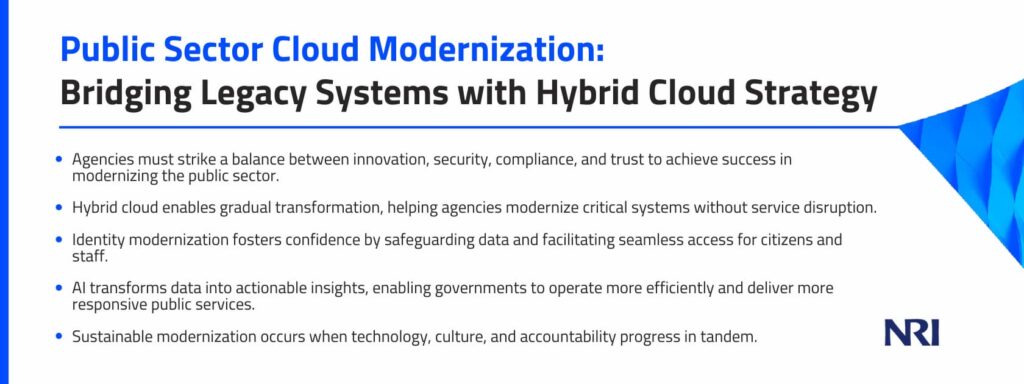
Public sector cloud modernization offers a path forward. By adopting hybrid cloud strategies, government IT leaders can integrate modern capabilities without abandoning mission-critical systems. This approach strikes a balance between agility and accountability, enabling agencies to modernize securely while maintaining public trust.
Drawing on NRI’s experience in government-sector transformation, this article explores how hybrid cloud design, identity modernization, and AI-enabled tools are redefining how agencies deliver secure, citizen-centric services.
The public sector modernization dilemma
Government IT leaders face a challenge unlike any other industry. They are expected to modernize decades-old infrastructure while maintaining citizen data security and ensuring uninterrupted services. Every system upgrade or migration must meet strict standards of reliability, transparency, and compliance.
Legacy environments have long supported public operations. However, their age now limits their agility and scalability. Many depend on outdated architectures that struggle to integrate with cloud platforms or support real-time data exchange. As agencies expand digital services, from online licensing to case management, these systems create silos that slow collaboration and innovation.
At the same time, public trust depends on stability. A single outage or security lapse can undermine confidence built over years. This tension leaves IT directors caught between two imperatives: accelerate modernization to meet new expectations, while ensuring the continuity and integrity of citizen services.
The challenge is no longer whether to modernize, but how to do it without sacrificing compliance, performance, or trust.
Why government IT is harder to modernize
Modernizing public sector IT is uniquely complex because success depends on more than technology. Leaders must balance technical, regulatory, and cultural forces that often move at different speeds.
Compliance and security mandates sit at the heart of this challenge. Data sovereignty, privacy regulations, and audit requirements limit the storage and location of government data. A Deloitte Insights study notes that many agencies face extended approval cycles before migrating workloads, which slows transformation and increases costs.
Technical constraints add another layer of difficulty. Legacy systems are often tightly coupled and customized for mission-critical operations. Replacing or integrating them with modern tools demands extensive planning and testing. The result is an environment that is functional but lacks flexibility.
Cultural barriers are equally influential. Government organizations tend to be risk-averse, shaped by budget cycles and procurement processes that discourage experimentation and innovation. Even when innovation is possible, change fatigue can reduce enthusiasm among teams accustomed to familiar systems and workflows.
Hybrid cloud as the bridge between legacy and the future
For IT Directors and VPs, these realities create a paradox of modernization. The technology to transform already exists, but adopting it safely and sustainably remains limited by regulation, culture, and legacy dependence.
For government agencies, replacing legacy systems outright is rarely possible. Hybrid cloud offers a balanced path that combines the reliability of on-premises systems with the agility of modern cloud platforms.
A Forrester report found that more than 60% of public sector technology leaders see hybrid models as the most practical way to modernize securely while meeting compliance goals. Agencies can move non-sensitive workloads to the cloud while keeping critical data in protected environments, reducing risk without disrupting essential services.
NRI supports this approach through hybrid adoption playbooks that align technology, culture, and compliance. Hybrid cloud becomes more than an infrastructure choice. It becomes the bridge that connects modernization with public trust.
Securing citizen services through identity modernization
Modernization depends on trust, and trust begins with a secure identity. Outdated systems slow access, increase errors, and expose vulnerabilities that weaken confidence.
Modern identity frameworks built on Zero Trust principles continuously verify every user, device, and connection to ensure security. This protects sensitive information while supporting flexible, cloud-based work environments.
For citizens, identity modernization simplifies access through single sign-on and consistent authentication across services. Agencies gain stronger compliance and clearer visibility into who accesses what and when.
NRI helps public sector clients design identity-first strategies that strengthen both security and the citizen experience, creating a lasting foundation for modernization and a secure cyber space.
AI-enabled modernization for public services
Artificial intelligence is becoming a cornerstone of public sector transformation. When applied thoughtfully, AI strengthens modernization by improving efficiency, accuracy, and the overall citizen experience.
It helps agencies automate manual tasks, analyze data more efficiently, and make informed decisions backed by factual evidence rather than assumptions. Within modernization initiatives, AI brings value across several critical areas:
- Automated case management: Reduces administrative backlogs and speeds up approvals for citizen requests.
- Predictive analytics: Anticipates community needs and optimizes resource allocation for public programs.
- Fraud detection and risk monitoring: Identifies unusual patterns early to prevent financial or data misuse.
NRI partners with government agencies to implement AI responsibly, ensuring that innovation enhances transparency, protects privacy, and maintains full compliance with public sector regulations.
Governance and compliance at scale
Governance is the backbone of sustainable modernization. For public agencies, innovation cannot come at the expense of compliance or security, and a scalable governance model enables this balance.
It promotes consistency, trust, and audit readiness by turning compliance from a periodic checkpoint into a continuous practice supported by real-time visibility. Within that framework, agencies can focus on several key priorities that strengthen modernization outcomes:
- Continuous compliance: Automated tools track configurations, access, and security controls in real time to maintain integrity across hybrid systems.
- Standards alignment: Frameworks such as FedRAMP, CJIS, and GDPR equivalents ensure that modernization efforts meet strict government and international requirements.
- AI-enabled monitoring: Machine learning detects compliance drift early and provides data-driven insights that support faster remediation and informed decision-making.
When governance and modernization advance together, agencies gain the agility to innovate while maintaining the oversight and transparency that citizens expect.
A modernization roadmap for agencies
Modernization is not a single milestone but a strategic journey that connects technology improvements with the broader mission of public service. A clear roadmap helps IT leaders strike a balance between continuity and change, ensuring every technical step supports measurable outcomes, such as uptime, security, and citizen satisfaction.
Within this roadmap, agencies can focus on practical steps that turn modernization goals into steady, achievable progress:
- Audit legacy workloads: Identify systems that can be migrated or retired first to minimize risk and reduce costs.
- Migrate domain and identity systems: Establish secure access controls that create a foundation for hybrid operations.
- Pilot AI-enabled applications: Introduce innovation gradually, gathering feedback and demonstrating value before scaling.
- Phase hybrid adoption: Transition workloads in stages to maintain service continuity and operational stability.
- Measure success by tracking performance through uptime, user satisfaction, and compliance readiness to guide ongoing improvement.
Agencies that take this structured, phased approach modernize with purpose rather than pressure, building resilient digital environments that can grow with citizen needs.
The true measure of modernization
Modernizing government IT is ultimately about people and trust. Technology is just one part of the modernization paradox. The true test of success lies in how well agencies strike a balance between innovation and security, agility and compliance, and progress and public trust.
Hybrid cloud creates that balance by linking legacy systems with modern capabilities. Identity modernization strengthens protection while making access seamless for citizens. AI empowers agencies with the intelligence to act faster and make more informed decisions. Strong governance ensures that every advancement is transparent and accountable.NRI helps government agencies design modernization frameworks that integrate technology, compliance, and culture from the start. Contact us to learn how our playbooks can help your organization modernize with confidence and lasting results.