
Focus on change metrics and KPIs that actually matter.
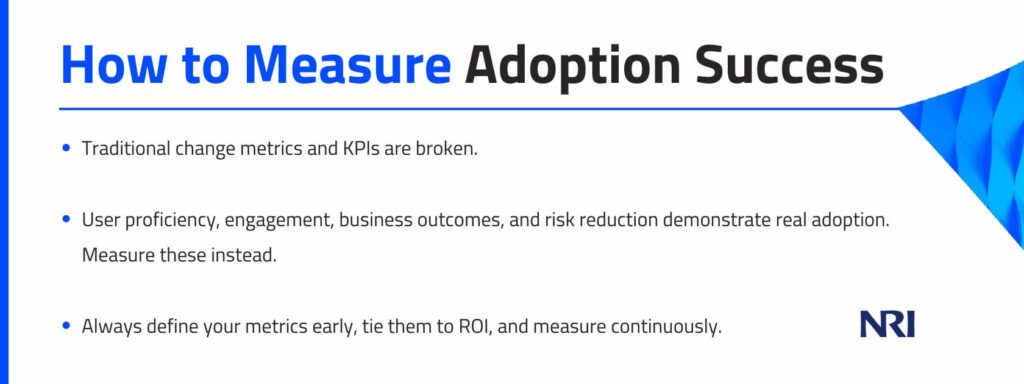
Ever declared a project “successful” at go-live only to watch everything quickly stall and wonder what went wrong? It’s because you threw your full weight into one half of the equation while neglecting the other. All too often, leaders focus on hitting technical milestones on time and budget without tracking one of the most critical change metrics and KPIs: user adoption. If you’re not measuring adoption, can you truly claim success? The short answer is no. You will essentially be flying blind and are more likely to end up with inflated success metrics and hidden failure points. In this article, we will discuss the change metrics and KPIs that actually matter and how to make your future initiatives more successful. Let’s dive in!
Why Traditional Metrics Don’t Work
Traditional metrics tell an incomplete story and are often poor proxies for engagement. Take, for instance, training session counts. Sitting through a training alone doesn’t make someone proficient. Neither does having 100% of staff attend multiple training sessions guarantee they’ll apply the new skills or start using the new technology.
Equally, focusing on project schedules and cutover dates alone won’t cut it. At the end of the day, a project can be delivered on time and on budget, with perfect system deployment and data migration, but what good is it if it’s met with resistance?
To achieve real, sustainable transformation, you need to track and improve people-centered metrics continuously. You need to ask: Beyond a successful “go-live,” do we know if our people are actually using the new tools or processes effectively? Are they empowered and seeing benefits?
Change Metrics and KPIs That Actually Matter
Here’s what to track in your next initiative:
- User Proficiency
How quickly do users become proficient with new systems or processes after completing training? This is called “speed to competency,” and it provides deep insights for improving the change. Shorter times, for instance, indicate effective training and enablement, while longer times reveal gaps in your strategy.
- Adoption and Engagement Rates
What percentage of the target audience is actively using the new tools or process 30, 60, or 90 days after go-live? For example, how many people in your sales team are making calls through that new CRM? Are analysts pulling data from that new BI tool? If adoption and engagement are low, intervene before the gap becomes permanent.
- Business Outcomes
Tie the change to operational and financial impact to confirm ROI from adoption. What are the efficiency gains? How much are the cost savings? Have customer satisfaction and NPS scores improved (and by how much) after making the change?
- Risk Reduction
Track the number of passed and failed audits before and after the change to verify whether your compliance posture is improving. Also, keep an eye on error reduction. For instance, if you automated data entry, how many fewer mistakes are there now? Or if your initiative delivers a quality improvement in manufacturing, what’s the reduction in defects?
Building Measurement Into the Process
- Establish Baseline Metrics Before Identity Migration or Modernization Rollouts
Capture current-state data for a “before vs. after” comparison. For example, measure how many people are using current systems, what the current error rates are, and what the productivity levels are, and then use that as a yardstick to quantify future improvements.
- Embed Metrics Into AI-enabled Application Modernization Initiatives
If your application modernization initiative integrates AI, bake in analytics and continuous monitoring from the start. This will make it magnitudes easier to track how many people use the app, how they interact with it, and the common navigation bottlenecks they’re facing.
- Use Dashboards To Align IT, Business, and Executive Leaders
Keep stakeholders aligned with transparent reporting. Build a balanced dashboard that combines IT, user, and business metrics so everyone works from the same data and sees adoption patterns and bottlenecks in real time. For instance, you can display adoption rates, process cycle times, error rates, and customer satisfaction on the same screen.
Turning Change Metrics and KPIs Into Business Value
Measuring adoption is only helpful if it leads to concrete improvements. To turn metrics into real business value, follow this three-step playbook:
- Define Metrics Early
Before project kickoff, engage key stakeholders to agree on a clear success definition and the KPIs that will prove it. Identify exactly what outcome you expect (e.g., “reduce process time by 30%” or “achieve 80% user adoption in 3 months”) and decide how to measure it. Ensure the criteria you’ll use covers both people and business outcomes, not just technical deliverables.
- Measure Continuously
Track adoption metrics throughout the initiative. A good practice is to set checkpoints at 30, 60, and 90 days post-launch to review KPIs. Each gives you a chance to catch trends early (such as when adoption plateaus or resistance rises) and course-correct.
- Tie Outcomes to ROI
Report outcomes to stakeholders in terms of business value. For instance, “Because 90% of our workforce adopted the new system within 60 days, we’ve cut costs by $X and boosted customer satisfaction by Y.” This will demonstrate momentum and build confidence in the initiative.
Get Expert Change Management Help From NRI
Delivering sustainable change is no easy task. Fortunately, NRI has been there and done exactly that. That’s why when the world’s most pre-eminent businesses want real adoption, they turn to our dedicated experts. No matter the scale of your digital transformation, we have what it takes to help you define, consistently measure, and report the change metrics and KPIs that actually matter. Schedule a free discovery call to achieve greater clarity of how you can accelerate adoption and ROI.