Safely modernize rigid retail systems by choosing application modernization vendors that understand transaction stability, legacy complexity, and omnichannel growth.
With modernization and digitalization shaping retail today, retailers are under pressure to operate differently, not only faster, but also more efficiently across stores, apps, websites, payments, inventory, and fulfillment.
Customers now expect accurate product availability, flexible delivery options, smooth checkout, and connected experiences wherever they shop. Yet those expectations depend on backend systems that can process pricing, orders, inventory, payments, and promotions in real time
For many retailers, that is where the problem starts. Legacy applications often sit behind modern customer-facing tools, slowing feature releases and making it harder to support omnichannel growth.
Application modernization helps retailers move away from monolithic systems and toward more flexible architecture built around APIs, cloud-native platforms, and microservices. That enables teams to release features faster, improve responsiveness, and support better coordination across physical and digital channels.
The risk is that retail systems don’t have much room for disruption. Short outages during modernization can affect sales, customer trust, and daily operations. Unfortunately, retail leaders identify the digital skills gap as their biggest challenge, according to research by The Info Team.
That’s why many enterprise retailers need application modernization partners that understand both legacy complexity and transaction-critical retail operations.
Continue reading to learn how to evaluate modernization vendors, what capabilities matter most, and which partners are best suited to support enterprise-scale retail transformation.
The Evaluation Blueprint: How Should Retailers Evaluate Application Modernization Vendors?
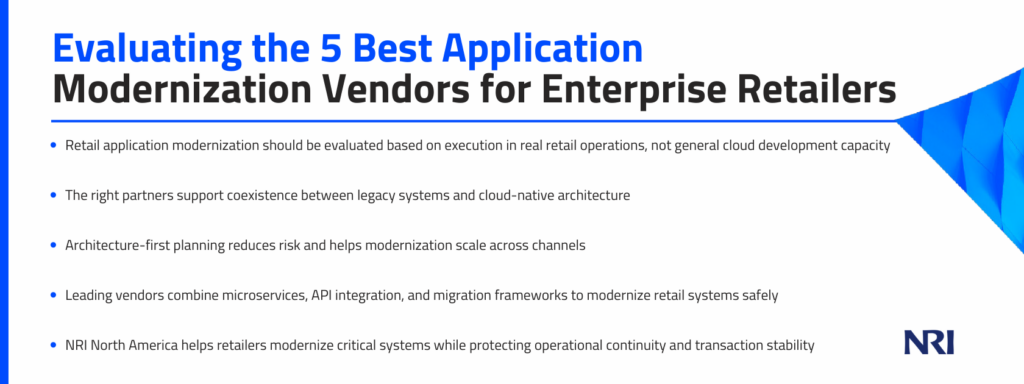
Retailers need clear evaluation criteria to separate true modernization partners from general cloud service providers. The right vendor should understand retail operations, legacy coexistence, and architecture-first planning.
- Retail domain and transaction fluency over generic cloud staffing
Retailers shouldn’t evaluate vendors only by the size of their cloud development teams. A large technical team still may not understand retail transaction flows, inventory dependencies, pricing rules, promotion logic, or supply chain timing.
A better approach is to evaluate retail-specific execution experience. Vendors should understand how POS, ERP, e-commerce, fulfillment, and inventory systems work together under real customer demand.
- Legacy coexistence and modernization bridge strategy
Most enterprise retailers can’t replace legacy systems all at once. Core systems still support payments, orders, stock movement, and daily store operations, so modernization must occur without disrupting continuity.
The right partner should define how legacy systems and cloud-native platforms will coexist during modernization. That bridge strategy allows retailers to modernize gradually while reducing operational risk.
- Architecture-first modernization planning
Retail modernization becomes expensive when coding begins before the target architecture is clear. Without upfront planning, teams often run into integration problems, duplicated work, and rework later.
Retailers should evaluate whether the vendor defines system blueprints, integration patterns, API layers, and scalability requirements before implementation begins. Architecture-first planning helps keep modernization practical, secure, and easier to maintain over time.
Successful application modernization depends on real operational impact, not surface-level technical claims. Retailers need partners that can modernize systems while protecting the stability of day-to-day operations.
The Technical Core: What Capabilities Should Application Modernization Vendors Have?
Retail application modernization depends on vendors capable of engineering systems for continuous operations. Retailers should look for partners with technical depth and practical migration discipline across the following areas:
- Microservices and event-driven architecture: These capabilities help reduce dependency on rigid monolithic systems and support faster, more flexible feature delivery.
- Secure, high-concurrency API layers: Retail systems need APIs that can connect POS, ERP, e-commerce, inventory, and payment systems without slowing transaction flows.
- Risk-managed migration frameworks: Approaches such as parallel testing and the strangler-fig pattern enable retailers to replace or rebuild parts of legacy systems gradually.
- Cloud-native engineering: Vendors should understand how to design scalable, resilient applications that support peak retail demand without unnecessary complexity.
- Operational continuity planning: Modernization should include clear testing, rollback, and monitoring plans so customer-facing and transaction-critical systems remain stable.
The best vendors combine architecture, engineering, and delivery discipline. That combination helps retailers modernize complex systems without putting sales, fulfillment, or customer trust at risk.
The Contenders: Who Are the Best Application Modernization Partners for Enterprise Retailers?
The enterprise retail modernization market includes global system integrators and specialized transformation partners. The best fit depends on how well each provider balances speed, operational stability, retail system expertise, and long-term architecture goals.
Below are the leading contenders in the enterprise application modernization space:
- NRI North America
NRI North America is positioned as a premier choice for enterprise retailers that require high-certainty, operations-first transformation. We offer advisory consulting services that guide organizations through modernization strategies, ensuring alignment between business goals, technology decisions, and execution.
With our help, you can modernize core retail systems by combining custom cloud-native engineering with deep business and supply chain alignment.
- Tata
Tata Consultancy Services is one of the largest global IT services providers supporting enterprise-scale modernization programs. It helps retailers transform legacy platforms through large delivery teams, industry accelerators, and long-term managed services models.
- Infosys
Infosys focuses on digital transformation and cloud-first modernization for large enterprises. It supports retailers by modernizing core systems, integrating omnichannel platforms, and improving operational efficiency through automation and analytics.
- Cognizant
Cognizant delivers application modernization services with a strong emphasis on cloud migration and digital engineering. It helps retailers streamline legacy systems while improving customer-facing digital experiences and backend performance.
- Capgemini
Capgemini specializes in end-to-end transformation programs that combine consulting, engineering, and managed services. It enables retailers to modernize application landscapes while maintaining continuity across complex, distributed retail operations.
Enterprise retailers typically evaluate these providers based on their ability to balance modernization speed, operational stability, and deep retail system expertise. The right choice depends on how well each partner aligns with transaction-critical performance requirements and long-term architectural goals.
The Business Impact: How Does Application Modernization Support Omnichannel Retail?
Retail application modernization helps synchronize inventory across stores, e-commerce platforms, fulfillment centers, and regional distribution networks. Customers can see more accurate stock availability, while teams gain better visibility into what can be sold, shipped, reserved, or replenished.
Modernized systems also help retailers launch digital capabilities faster. Mobile apps, loyalty programs, payment options, promotions, and fulfillment features become easier to develop when backend systems are flexible enough to support change.
Better architecture also improves operational resilience. When core systems are easier to integrate and scale, retailers can respond faster to demand spikes, seasonal pressure, and changing customer expectations.
Build a Scalable Digital Substrate With NRI
A flexible application foundation gives retailers the room to move faster across digital and physical channels. However, modernization only works when core systems can change without putting operations, transactions, or customer trust at risk.
If you’re looking to move in that direction, partnering with NRI can help you get there with confidence. We help enterprise retailers modernize critical applications, connect legacy systems with cloud-native architecture, and align modernization efforts with operational continuity.
Contact NRI today to explore how your organization can modernize retail applications while maintaining uninterrupted operations.