
Discover how to build cyber resilience in 2026 and beyond.
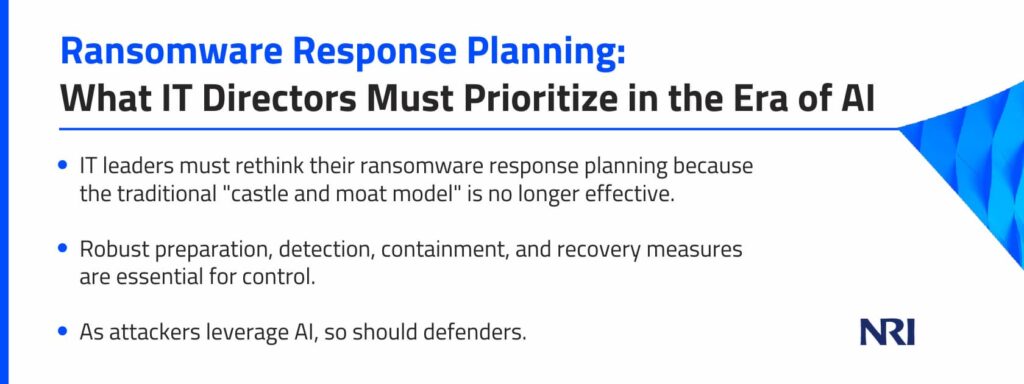
How is your defense strategy keeping up as nefarious actors leverage artificial intelligence (AI) to launch faster and more intelligent ransomware attacks?
Today’s ransomware attacks are no longer the noisy, hit-and-run extortions of a few years ago. They are surgical, patient, automated, and increasingly target critical infrastructure and hybrid environments due to their complexity and dependency.
Easy access to off-the-shelf hacking tools has made it so that attackers no longer need to be tech-savvy. If they can read, write, and click, they can launch a full-scale intrusion even on large enterprises.
Using AI, for instance, attackers can map your environment and decide within minutes which system will inflict the most pain. And they aren’t just after files anymore. They want control of processes that, when disrupted, threaten safety, compliance, and customer trust.
Are you ready for when an attacker comes knocking?
Ransomware response planning demands a new level of urgency.
Traditional Response Plans Aren’t Fit For This New Age
Legacy playbooks still assume a strong perimeter will halt attacks.
However, modern hybrid networks and cloud environments have effectively dissolved the traditional “moats” as we once knew them. That means that once an attacker breaches a boundary, flat or poorly segmented networks allow unchecked lateral movement.
Moreover, the complexity of hybrid environments easily creates blind spots in the old model. Some services you use may live outside the visibility of traditional monitoring solutions, thereby limiting ransomware detection and response.
Finally, traditional response plans focus on recovery rather than continuity during an active attack. They are therefore inadequate for energy and operations-heavy industries with “always-on” requirements, and where downtime is unacceptable.
That’s why you need proactive ransomware response planning.
The Core Pillars of a Modern Ransomware Response Framework
When it comes to ransomware response planning, the rule of thumb is that the faster you can detect, isolate, and recover, the better your chances of staying in control.
Focus on these four areas:
1. Preparation
You can’t protect what you don’t know exists.
- Maintain a live asset inventory of all assets, from cloud instances to connected sensors.
- Label what’s mission-critical, what’s nice-to-have, and what you can live without for a few hours.
- Build clear runbooks that outline who is responsible for what actions when alarms are triggered. Then rehearse them until everyone’s role becomes second nature.
2. Detection
Reactive monitoring won’t cut it anymore.
- Utilize AI and machine learning to identify patterns that your analysts might miss, such as unusual logins, traffic flows, or when an attacker is attempting to move laterally across your network.
- Feed everything into a unified security information and event management (SIEM) or extended detection and response (XDR) platform that automatically connects the dots for you.
- Finally, treat detection like an ongoing conversation, not a one-time setup.
3. Containment
The goal here isn’t to shut everything down. It’s to isolate the damage while keeping the lights on.
- Segment your networks and apply Zero Trust principles so compromised systems can’t reach clean ones.
- Automate quarantine and access control responses when triggers fire.
- Balance containment with continuity. Avoid overreacting and taking healthy systems offline.
4. Recovery
Backups are your insurance policy. But only if they work.
- Store immutable, offline backups that can’t be altered by ransomware.
- Test them frequently, and verify every restore.
- Prioritize recovery in stages: first, get the essentials back up, then restore everything else.
NRI can help you build a strategy-first framework for hybrid environments, not just a cloud or on-premises one. Ask us how.
Integrating AI into Defense and Response
As nefarious actors launch ransomware offensives using AI, smart organizations are using it for defense. According to IBM’s 2025 Data Breach Report, at least 72% of businesses have enhanced their defense and response capabilities with Security AI. Those who extensively use AI (about 32%) reduced their mean time to identify and contain a breach by 80 days. Their breach costs are also lower ($3.62 million) compared to the global average ($4.44 million) and that of companies that don’t use security AI ($5.52 million).
Here’s what to do:
- Utilize AI across the entire cybersecurity lifecycle, from prevention to detection, investigation, and response, not just select areas.
- Tap on the power of humans-AI augmentation. Let algorithms do the heavy lifting on triage and analysis, so your team can focus on judgment and action.
- Create real-time dashboards for executives to track the status of threats (e.g., what’s infected, what’s contained, and what’s safe to restore) during incidents.
AI isn’t the enemy. It can work for you if you build it into your ransomware defense playbook.
On Governance, Compliance, and Business Continuity
Remember, ransomware response planning isn’t just an IT agenda. It should be included in your corporate governance strategy.
- Get Leadership Involved: Cyber resilience needs to be on the board’s radar, not buried in the CISO’s inbox.
- Make Zero Trust Your Baseline: Always verify access, and limit privileges wherever possible.
- Know Your Compliance Windows: Many industries now have hours, not days, to disclose incidents. Build those timelines into your plan.
- Check Your Insurance and Vendors: Policies are tightening, and third-party breaches can become your problem fast.
- Plan for Continuity: Even in the midst of an attack, you should be able to maintain critical services.
Need expert help with your ransomware response planning?
Build a Resilient, Future-Proof Ransomware Playbook With NRI
Attackers are already using AI to outthink your defenses. It’s time to use the same technology to withstand offensives and avoid downtime as well as downstream impacts on revenue, customer trust, and compliance.
NRI can help you develop an adaptable framework with practical steps and metrics for resilience in the age of AI and beyond. Get in touch to learn more.