
Discover the role of change management in unifying stakeholders, reducing friction, and driving enterprise-wide innovation.
Let’s be honest: the most challenging part of any large-scale IT initiative isn’t technical execution. It’s getting people to use what you just spent months (and money) rolling out. You can deploy a flawless cloud migration, automate half your workflows, or launch the best-in-class analytics platform. Still, if your team feels that the change doesn’t make sense to them, disrupts their flow, or just introduces “another system” they have to learn, they will likely cling to old habits and resist change, and the initiative won’t take off.
Effective change management bridges the gap between IT and business teams so that your organization aligns technical transformation with human adoption. This ensures new technologies and processes are embraced, not resisted, leading to smoother transitions, improved productivity, and stronger collaboration.
The Rising Stakes of Change in Modern Organizations
Not long ago, you only needed to roll out a significant technology change once every few years. But things have changed tremendously, and organizations now find themselves needing to evolve constantly. There are a few reasons for this. First, modern technology advances at breakneck speed. That means what works this year may be obsolete next year. Similarly, markets now move faster than ever and are ultra-competitive. Your existing competitors are constantly innovating, and every once in a while, a new entrant pops up with a disruptive business model. All the while, privacy laws, compliance requirements, and security mandates have become moving goal posts. Building change management as a core competency has never been more critical.
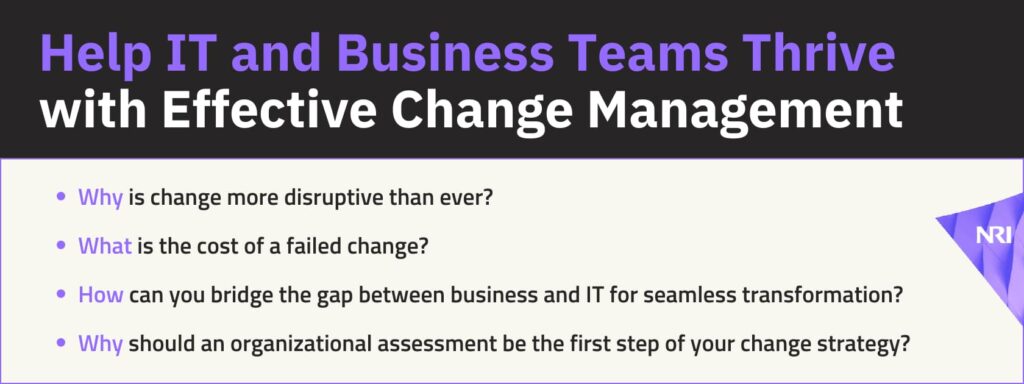
Change is More Disruptive Than Ever
So what makes change more disruptive in 2025 than a decade ago? For starters, our world is everything is now more connected. As infrastructure, apps, and data are deeply intertwined, even a small change can create enterprise-wide ripples. Swap out a login method and suddenly dozens of teams need to relearn how they access systems. Launch a new collaboration tool, and you’’re not just changing chat; you’, you’re changing how people work, communicate, and store information.
Additionally, change now moves faster than it traditionally has. So if not effectively managed, updates may land faster than people can fully adapt. Without a structured framework to guide them, even well-intentioned changes will often be met with workarounds, resistance, or outright disregard.
The Cost of Failed Change
It is well documented that nearly 70% of change initiatives fail. Less talked about are the consequences of failed change. Let’s quickly highlight some of them.
- Missed ROI: Without adoption, all potential efficiency gains, revenue, and business impacts never get realized. Yet considerable money, time, and effort are already expended on the initiative.
- Erosion of Trust: Business teams may start seeing IT as a source of disruption rather than an enabler. As a result, future projects may face more skepticism and pushback.
- Talent attrition: Burnout from constant, poorly managed change drives your best technical and business talent out the door.
- Shadow IT: Employees may resort to using unsanctioned tools, creating potential security and compliance gaps.
As mentioned, often when change initiatives fail, it’s because there’s a disconnect between the people who build the solutions and the people who use them. Let’s explore how to bridge this gap.
How to Bridge the Gap Between Business and IT
To ensure your change initiative is built on a solid foundation, involve the business team right at the discovery phase, not after plans are set. Ask them to walk you through their daily workflow and pain points before discussing potential technology upgrades to implement. When communicating about the change, use terms that both IT and business teams understand. Ensure there’ Ensure there’s alignment on key performance indicators (KPIs). If business and IT don’t measure the same thing, they won’t row in the same direction. So define the KPIs that matter to both sides and review them together at regular intervals. At the same time, form change teams with members from both departments to test, communicate, and advocate for adoption. Finally, keep feedback loops open so you can act on insights shared by both parties.
Take the First Step In Defining Your Change Strategy
For a seamless transformation, it’s imperative to define a change strategy that’s tailored for your organization. You don’t want just to take a one-size-fits-all approach and try every single change management tool or framework that’s available. Instead, you want to tailor it and target the things that are most important to your organization. That’s where organizational change assessment comes in.
Part of the reason why change readiness assessments are so critical is that they allow you to proactively identify where the risks and where the change management issues are likely to lie. Sometimes, organizations make the mistake of rolling out change under the assumption that it will be easy to manage, or that resistance to change won’t be an issue, as people are excited about the new vision and the opportunity to utilize the latest tools and implement better processes. That probably is true, but inevitably, as you get further into the transformation, you find that people will resist change. The key isn’t to identify or answer the question of whether or not people resist change; it’s how much they will resist change, who exactly will resist the change, and what the root causes of that resistance are.
An organizational change assessment allows you to create a tailored and more prescriptive approach to change management. By proactively identifying potential sources of resistance, you can anticipate and addressget ahead of them and create a change strategy and plan that addresses those needs.
NRI can help you assess how ready your organization is for change, find potential points of resistance, and build a strategy that bridges gaps between your business and IT functions. Contact us today for a custom change readiness assessment.